The best trees for Tacoma landscapes are Western Red Cedar, Douglas Fir, Japanese Maple, Pacific Dogwood, Vine Maple, Kousa Dogwood, and Japanese Flowering Cherry. After 20 years of designing and planting trees across Tacoma, Gig Harbor, and Puyallup, I’ve watched homeowners make the same expensive mistakes. Wrong tree, wrong spot. The Pacific Northwest is generous with rainfall, but Tacoma’s clay-heavy soils and variable microclimates still demand smart plant selection. Get it right, and your tree canopy pays you back in property value, privacy, and beauty for decades.
Chris’ Quick Takeaways
- Western Red Cedar and Douglas Fir are built for Tacoma’s wet climate, but size them honestly against your lot before you commit.
- Japanese Maple is not fragile here. Tacoma’s Puget Sound climate is genuinely ideal for it.
- Pacific Dogwood blooms twice a year. No other native tree on this list does that.
- If you love dogwoods but keep losing them to disease, switch to Kousa Dogwood.
- Vine Maple is the most underused native tree in Tacoma landscaping. Give it the shade it wants and it will reward you.
- Japanese Flowering Cherry lives 15 to 20 years. Go in knowing that and plan accordingly.
- Wrong tree, wrong spot is the most expensive mistake I see on Tacoma properties. Get the placement right first.
1. Western Red Cedar
What Makes It Right for Tacoma’s Wet Climate
Western Red Cedar (Thuja plicata) is as Pacific Northwest as rain itself. I’ve planted more of these than I can count across Tacoma properties, and they never disappoint. This native tree thrives in our heavy clay soils and wet winters, resisting rot and shrugging off the kind of prolonged moisture that destroys less-adapted species. The Coast Salish tribes called it the “tree of life” for good reason. It simply belongs here.
How Big It Gets and How Fast
According to the USDA Forest Service, Western Red Cedar typically reaches 50 to 75 feet in residential settings, growing 2 to 3 feet per year under good conditions. That is meaningful growth without being reckless. One particularly notable Washington specimen recorded a trunk diameter of 233 inches, which tells you everything about this tree’s staying power. Plant it with its mature height in mind, and it will outlive every fence you ever install.
Best Spots to Plant It on Your Property
A retired couple in North Tacoma wanted privacy from a busy street without losing their open yard feel. We planted a row of Western Red Cedars along their property line and the problem was solved within three seasons. Keep them well away from underground utility lines and power lines, as mature height can create serious conflicts over time. They perform beautifully as windbreaks, privacy screens, or anchor trees in larger landscape designs throughout Gig Harbor and Puyallup.
Table: 7 Best Trees for Tacoma Landscapes
| Tree | Type | Mature Height | Growth Rate | Best Use | USDA Zone |
| Western Red Cedar | Evergreen Native | 50–75 ft | Fast (2–3 ft/yr) | Privacy screen, windbreak | 5–8 |
| Douglas Fir | Evergreen Native | 80–100 ft | Moderate–Fast | Large lots, carbon sequestration | 4–6 |
| Japanese Maple | Deciduous Ornamental | 10–25 ft | Slow–Moderate | Specimen, focal point | 5–8 |
| Pacific Dogwood | Deciduous Native | Up to 66 ft | Moderate | Understory, wildlife garden | 7–9 |
| Vine Maple | Deciduous Native | 16–26 ft | Moderate (1–2 ft/yr) | Shady spots, woodland screen | 4–8 |
| Kousa Dogwood | Deciduous Ornamental | 15–25 ft | Slow | Small lots, specimen tree | 5–8 |
| Japanese Flowering Cherry | Deciduous Ornamental | 15–25 ft | Moderate | Curb appeal, driveway planting | 5–8 |
2. Douglas Fir
Why It Dominates the best trees Pacific Northwest Lists
Douglas Fir (Pseudotsuga menziesii) is the quintessential Pacific Northwest tree, and honestly, it earned that reputation. I respect this tree deeply because it does so much at once: it provides year-round screening, supports bird species and wildlife, and sequesters carbon dioxide at a remarkable rate. A 2024 USDA Forest Service study published in PLOS ONE found that Douglas fir forests accumulate aboveground carbon at 2.26 tC/ha per year, the highest rate of any measured forest type group on the West Coast.
Mature Size and Root System Considerations
This is where I have to be straight with you: Douglas Fir gets big. In residential settings it regularly reaches 80 to 100 feet, with a deep, expansive root system that demands respect during tree planting. Keep it a minimum of 30 feet from your home’s foundation and well clear of underground utility lines. Give it that space and it becomes one of the most structurally sound, wind-resistant evergreen trees you can grow on a Tacoma or Gig Harbor property.
When Douglas Fir Is the Wrong Choice
A homeowner in University Place learned this the hard way. In the early 2000s, a previous owner had planted two Douglas Firs about 12 feet from the house, and by the time we visited, the roots were interfering with drainage lines. Smaller lots, tight urban yards, and properties near power lines are genuinely wrong fits for this tree. On those sites, I usually recommend Western Red Cedar or Vine Maple as better-scaled alternatives that still deliver that authentic Pacific Northwest character.
3. Japanese Maple
The Best Cultivars for Tacoma Gardens
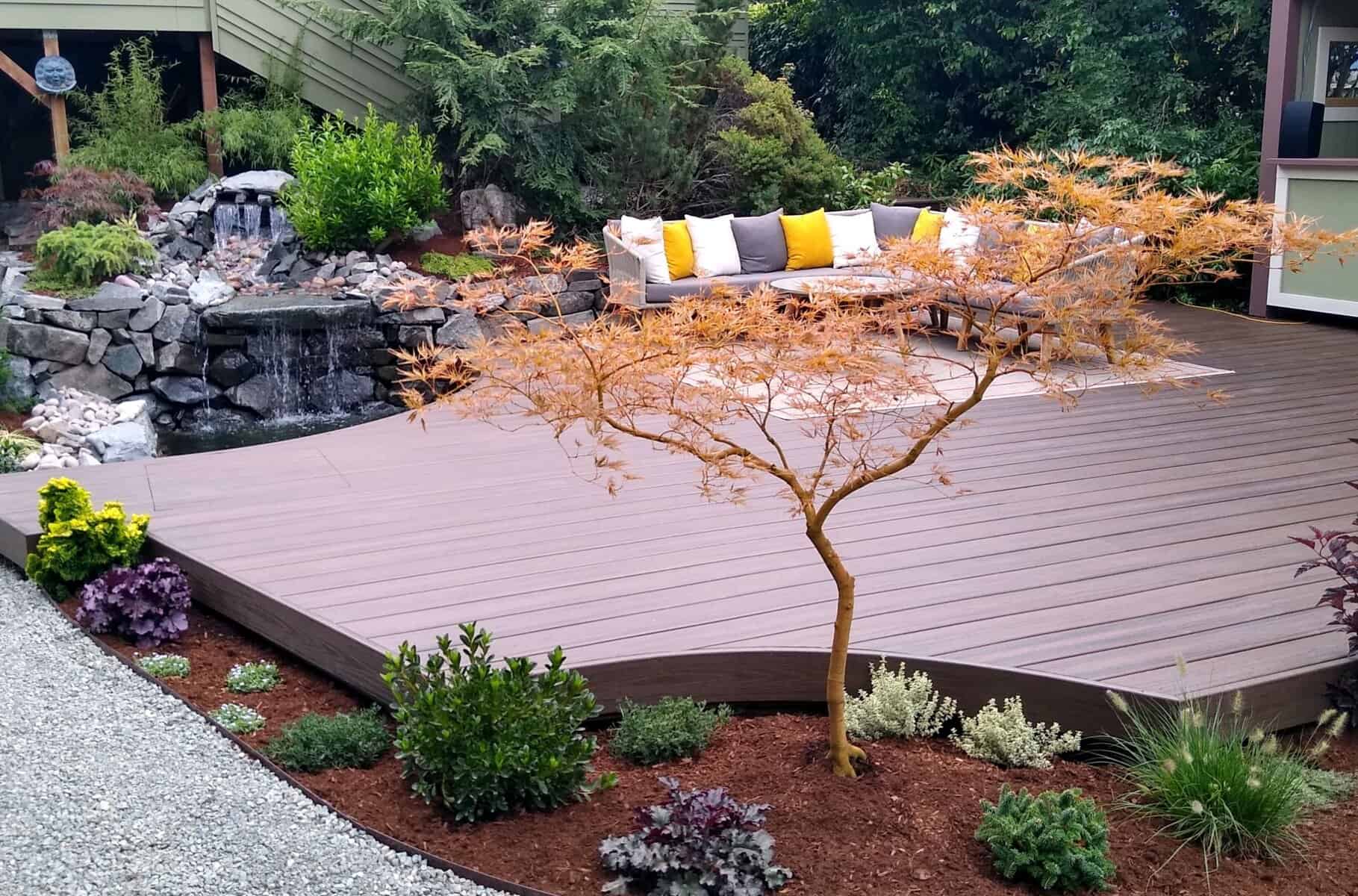
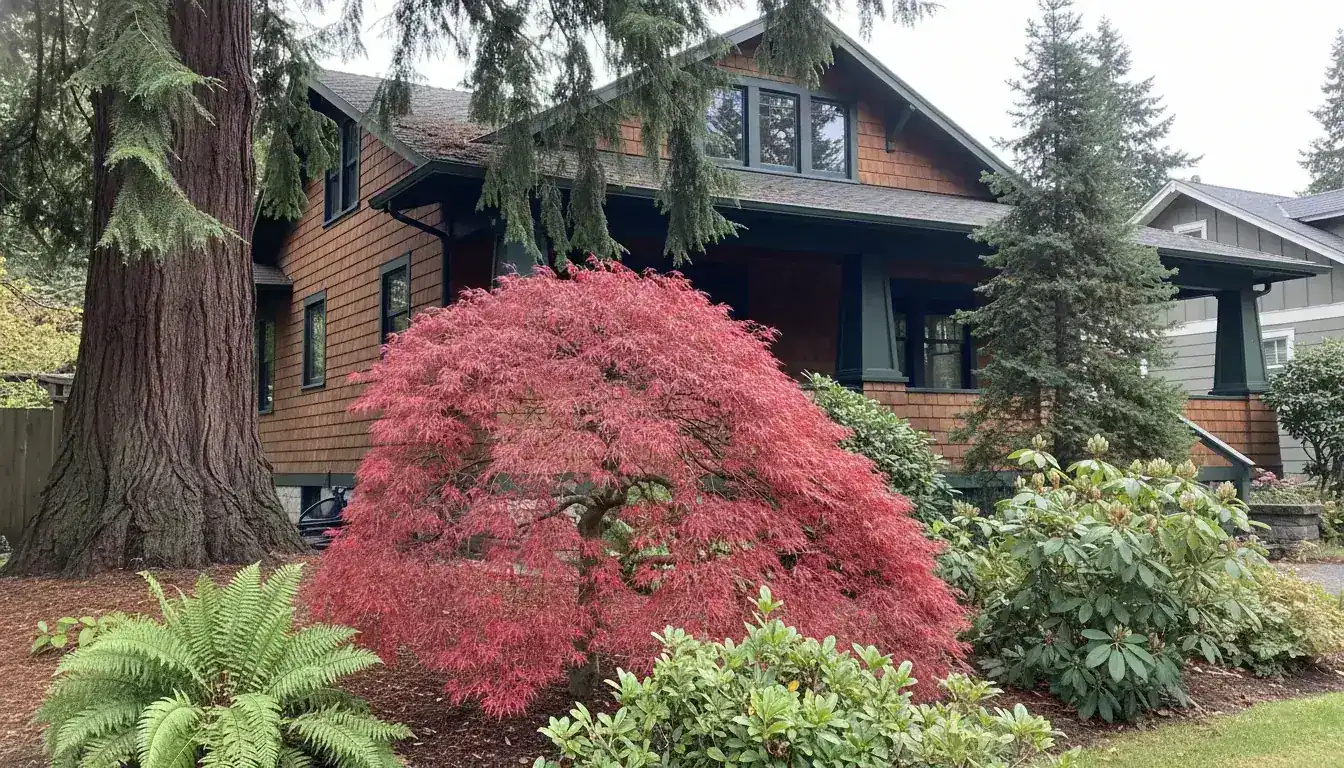
Few trees stop people in their tracks the way a well-placed Japanese Maple (Acer palmatum) does, and I say that after 20 years of watching clients’ reactions when they see one in full fall color. Washington’s Puget Sound region sits perfectly within USDA Hardiness Zones 5a to 8b, making it genuinely ideal for this tree. My top cultivars for Tacoma gardens are Bloodgood for its deep burgundy foliage, Sango Kaku for its coral bark winter interest, and the weeping Tamukeyama for smaller spaces.
How Much Sun and Water It Actually Needs
Japanese Maples prefer morning sun and afternoon shade, which conveniently describes a large number of Tacoma lots with western or northwestern exposures. They need consistently moist, well-drained, slightly acidic soil and do not tolerate waterlogged conditions, which matters given our clay-heavy ground. During the first two summers after planting, consistent watering is non-negotiable. Once established, they are reasonably self-sufficient through our wet Pacific Northwest winters with minimal supplemental irrigation needed.
Using It as a Focal Point or Specimen Tree
Two homeowners in their 50s approached us with a beautifully landscaped Gig Harbor property that felt like it was missing a centerpiece. We installed a mature Bloodgood Japanese Maple at the bend of their front path, and it completely anchored the design. As a specimen tree, it works best with breathing room on all sides and a clean underplanting of Western Sword Fern or low groundcover. Good landscape design puts this tree where it can be seen from both inside the home and from the street.
4. Pacific Dogwood
Four Seasons of Visual Interest in One Tree
Pacific Dogwood (Cornus nuttallii) is one of those native trees that genuinely earns its place in the landscape every single month of the year. According to the USDA Forest Service, it can grow up to 66 feet tall and is one of the few native trees that flowers both in spring and again in fall, giving you two bloom periods annually. White blooms in spring, lush green foliage in summer, brilliant red berries and scarlet leaves in autumn, and clean architectural branching in winter.
Soil and Light Conditions It Prefers
Pacific Dogwood grows naturally as an understory tree beneath Douglas Fir and Western Red Cedar, which tells you exactly what it wants: dappled light, moderate moisture, and protection from harsh afternoon sun. I always recommend planting it on the north or east side of a property where it gets gentle morning light without the intensity of a southwestern exposure. It prefers well-drained, slightly acidic soil and performs best when mulched generously at the base to retain moisture through our dry Tacoma summers.
Disease Resistance and What to Watch For
A family in Puyallup had planted a Pacific Dogwood themselves several years before calling us. It had developed classic symptoms of dogwood anthracnose, a serious fungal disease caused by Discula destructiva that has caused widespread mortality of native dogwood trees across the United States since it was first reported in the 1970s. Increased air circulation through selective pruning is your best preventative tool. I also recommend avoiding overhead irrigation and keeping fallen leaf litter cleared from the base throughout the season.
5. Vine Maple
Why It Thrives in Tacoma’s Shady Spots
Vine Maple (Acer circinatum) is the unsung hero of Pacific Northwest landscaping, and I genuinely think it deserves far more attention than it gets. It is cold-hardy to USDA Zone 4, meaning Tacoma’s maritime climate is practically a vacation for this tree. Very few deciduous native trees perform well beneath the dense canopy of Douglas Fir and Western Red Cedar, but Vine Maple does it naturally, handling our wet winters and dry summers without complaint once established.
How to Grow It as a Tree vs. a Shrub
This is where plant selection gets interesting. Left to its own devices, Vine Maple grows as a multi-stemmed spreading shrub reaching 16 to 26 feet. If you want a more upright, tree-like form, selectively remove competing stems early and train a single dominant trunk upward with light annual pruning. A young couple in South Tacoma wanted a naturalized woodland screen along their back fence line, so we let three Vine Maples grow in their natural shrubby form, and within four years the result was a lush, layered native plants backdrop.
Fall Color and Winter Structure
If you want honest fall color without importing anything exotic, Vine Maple delivers yellows, oranges, and deep crimsons that rival Japanese Maple in a good autumn. I love using it in designs where clients can see it from interior windows during the Northwest’s grey months, because the branching structure is genuinely beautiful even without leaves. It cycles nutrients faster than conifers, enriching your soil naturally, and its moss-covered branches develop real character over time in shaded Tacoma and Gig Harbor gardens.
6. Kousa Dogwood
How It Outperforms Native Dogwood in Disease Resistance
If you have ever admired a Pacific Dogwood and then watched it slowly decline from disease, Kousa Dogwood (Cornus kousa) is the answer you have been looking for. Both NC State Extension and NC Cooperative Extension confirm that Kousa Dogwood shows significantly stronger resistance to dogwood anthracnose, powdery mildew, and dogwood borers, the same diseases that have caused extensive native dogwood mortality across the United States since the 1970s. For Tacoma homeowners who want dogwood beauty without the heartbreak, this is the more reliable choice.
Spring Bloom Timing and What to Expect
Something I genuinely appreciate about Kousa Dogwood is that it blooms two to three weeks after native dogwoods fade, which effectively extends your spring flowering season without planting a single additional tree species. The creamy white pointed bracts appear after the leaves emerge, covering the tree in a layered, elegant display through late spring. An architect in her 40s renovating a Tacoma craftsman bungalow specifically requested this tree after seeing one in a neighbor’s yard mid-June, well past when everything else had finished blooming.
Sizing It Correctly for Smaller Tacoma Lots
Kousa Dogwood grows slowly, reaching only about 10 feet in its first 15 years according to NC Cooperative Extension, which makes it genuinely manageable on tighter urban properties. Its mature height of 15 to 25 feet and similar spread fits comfortably in the mid-layer of a well-designed landscape without overwhelming neighboring plants or structures. I regularly recommend it for Tacoma lots where clients want a flowering specimen tree with four-season interest but cannot accommodate the footprint of larger tree species.
7. Japanese Flowering Cherry
The Best Varieties for the best trees Tacoma Homeowners Plant
Japanese Flowering Cherry (Prunus serrulata) is the tree that makes entire neighborhoods stop and stare every April, and after 20 years of landscape design work across Tacoma and Gig Harbor, I still get a little excited when these come into bloom. My top recommendations for Tacoma homeowners are Kanzan for its dramatic double pink blooms packed with 20 to 30 petals per flower, Shirofugen for its later-blooming white and pink display, and the columnar Amanogawa for narrow spaces where width is limited but impact is not.
Placement Tips for Maximum Curb Appeal
A couple in their early 60s in Gig Harbor wanted their long driveway entrance to feel like an event rather than just a path to the garage. We planted alternating Kanzan cherries along both sides at 20-foot intervals, and the spring canopy effect was exactly what they had envisioned. Position Japanese Flowering Cherry trees where they receive full sun and good air circulation, at least 10 to 15 feet from structures. The street-facing front yard is genuinely their best stage for maximum curb appeal and property value impact.
Lifespan, Maintenance, and What It Demands
I always tell clients upfront: Japanese Flowering Cherry is a short-lived investment. NC State Extension confirms an average lifespan of just 15 to 20 years, so go in with realistic expectations. These trees prefer moist, well-drained loamy soil and will not tolerate waterlogged conditions, which means soil preparation matters significantly on Tacoma’s clay-heavy ground. Annual light pruning, good air circulation, and avoiding overhead irrigation will stretch their lifespan and keep them performing beautifully through every spring bloom season.
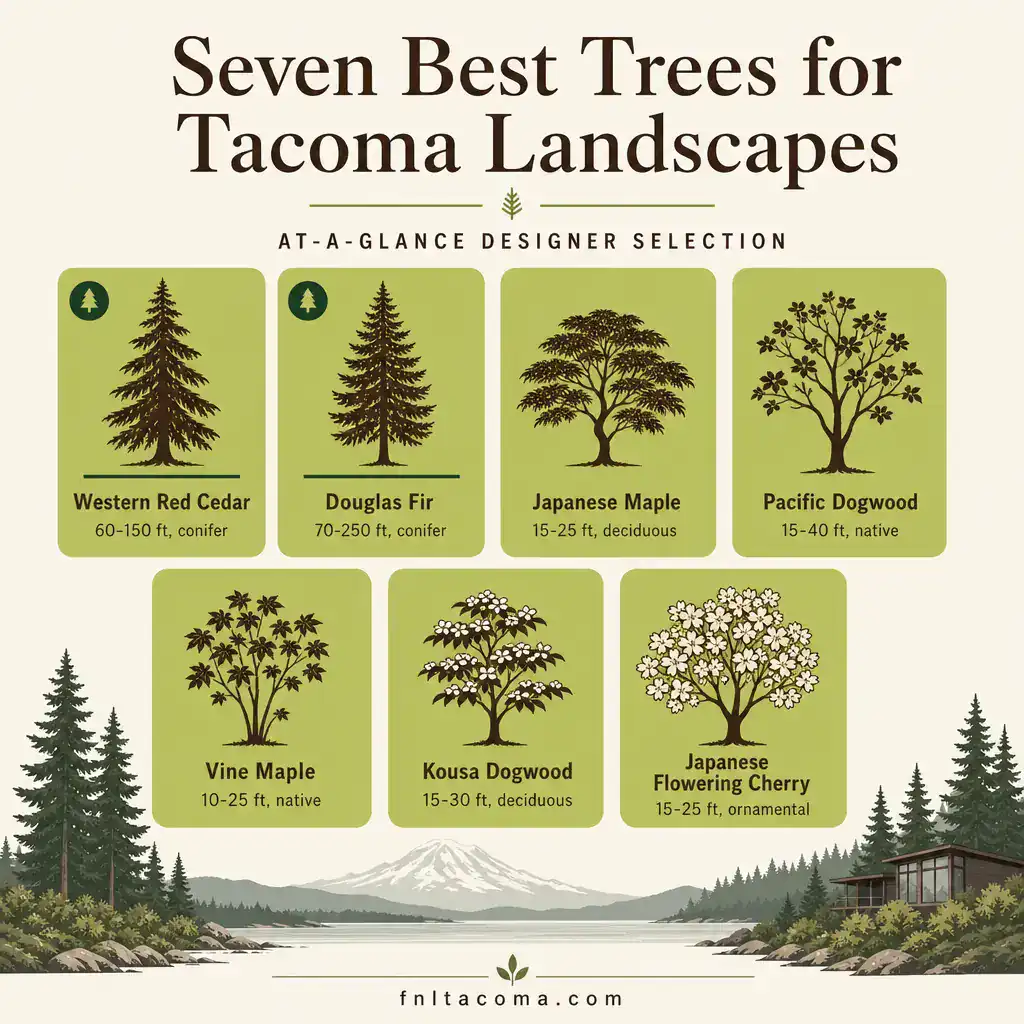
Seven trees that earn their spot in Tacoma landscapes — native conifers, ornamental Japanese maples, and dogwood favorites at a glance.
How to Pick the Right Tree for Your Tacoma Property
Matching Tree Size to Your Lot
The single most common tree mistake I see on Tacoma properties is a size mismatch. Someone falls in love with a Douglas Fir at the nursery, plants it eight feet from the house, and ten years later it is a problem. Before any tree planting decision, measure your available space honestly and research mature height and spread. A good rule of thumb I share with every client:
- Small lots under 5,000 sq ft: stick to trees under 25 feet at maturity such as Japanese Maple, Kousa Dogwood, or Japanese Flowering Cherry
- Medium lots 5,000 to 10,000 sq ft: mid-sized trees like Pacific Dogwood and Vine Maple work beautifully
- Large lots over 10,000 sq ft: Western Red Cedar and Douglas Fir finally have the room they deserve
Evergreen vs. Deciduous for Pacific Northwest Yards
This is a question I get constantly, and the honest answer is that the best Tacoma landscapes use both strategically. Evergreen trees like Western Red Cedar provide year-round privacy, wind protection, and structure through our grey winters when you need visual anchoring the most. Deciduous trees like Japanese Maple and Vine Maple give you seasonal drama, allow winter light into south-facing windows, and cool your outdoor spaces naturally in summer. Consider these factors when deciding:
- Privacy needs: evergreen trees win for screening neighbors and road noise year-round
- Seasonal interest: deciduous trees deliver spring blooms, fall color, and winter branch structure
- Energy efficiency: deciduous trees on the south and west sides of your home can reduce summer cooling needs noticeably
- Maintenance: evergreen trees generally drop less debris but require more structural pruning as they mature
Soil, Drainage, and Tacoma’s Clay-Heavy Ground
Tacoma’s soil is predominantly clay-heavy, which is genuinely one of the most important factors in tree selection and planting success that most homeowners completely overlook. Clay retains moisture well but drains poorly, creating waterlogged conditions that suffocate root systems and kill otherwise healthy trees within a couple of seasons.
A Puyallup homeowner in his late 40s lost two Japanese Flowering Cherries back to back before calling us. We diagnosed the issue immediately as poor drainage and amended the planting area before his third tree went in. That one is still thriving. Soil preparation steps I recommend for Tacoma properties:
- Test your soil drainage by digging a 12-inch hole, filling it with water, and measuring how long it takes to drain
- Amend heavy clay with compost at a ratio of roughly one part compost to three parts native soil
- Plant trees slightly high, with the root flare sitting just above grade to prevent crown rot
- Mulch generously to 3 to 4 inches depth, keeping mulch away from the trunk itself
- For bare root trees planted in fall, water deeply once a week through the first dry season
Father Nature Landscapes Can Plant It Right the First Time
Choosing the right tree is only half the equation. Planting it correctly, in the right location, at the right depth, with the right soil preparation, is what determines whether that tree thrives for decades or quietly struggles and fails. Since 2006, our trained horticulturists have completed 500-plus projects across Tacoma, Gig Harbor, and Puyallup, and we understand this region’s clay soils, microclimates, and plant selection challenges at a level that goes well beyond basic maintenance.
The City of Tacoma currently has just 21 percent tree canopy coverage, the lowest of any city assessed in the Puget Sound region, with a goal of reaching 30 percent by 2030. Every well-chosen, properly planted tree on your property contributes to that goal while directly enhancing your property value, your privacy, and your daily quality of life. Your beautiful, easy-living landscape is just a conversation away. Schedule your project consultation with Father Nature Landscapes today.
Table: Tacoma Tree Planting Cheat Sheet: Common Problems and Solutions
| Problem | What Causes It | Best Tree Choice | What to Avoid |
| Heavy clay soil with poor drainage | Tacoma’s native soil composition | Vine Maple, Western Red Cedar | Japanese Flowering Cherry, Pacific Dogwood |
| Too much shade from existing conifers | Douglas Fir and Cedar canopy | Vine Maple, Kousa Dogwood | Japanese Flowering Cherry, Douglas Fir |
| Small urban lot under 5,000 sq ft | Limited planting space | Japanese Maple, Kousa Dogwood | Douglas Fir, Western Red Cedar |
| Slope erosion on property | Steep grade, heavy rainfall | Western Red Cedar, Vine Maple | Japanese Flowering Cherry |
| Overhead or underground utility lines | Mature height conflicts | Japanese Maple, Vine Maple | Douglas Fir, Western Red Cedar |
| Wanting maximum spring curb appeal | Seasonal visual impact goal | Japanese Flowering Cherry, Kousa Dogwood | Douglas Fir, Western Red Cedar |
| Supporting local birds and pollinators | Ecological planting goals | Pacific Dogwood, Vine Maple, Pacific Crabapple | Japanese Flowering Cherry |
| Replacing a failed native dogwood | Dogwood anthracnose history | Kousa Dogwood | Pacific Dogwood |
Frequently Asked Questions
1. Are native plants always the best choice for Tacoma landscapes?
Native plants are often the smartest starting point because they evolved alongside our Pacific Northwest conditions. That said, well-adapted non-natives like Kousa Dogwood and Japanese Maple can thrive here just as reliably when planted correctly.
2. What trees does the Washington Native Plant Society recommend for Western Washington yards?
The Washington Native Plant Society consistently highlights species like Vine Maple, Pacific Dogwood, and Oregon White Oak for their ecological value and regional adaptability. I reference their guidance regularly when building plant lists for Tacoma and Gig Harbor clients.
3. What is a good place to see mature Pacific Northwest trees before choosing one?
Point Defiance Park contains remarkable examples of old-growth Western Red Cedar, Douglas Fir, and big leaf maple (Acer macrophyllum) that give you a realistic sense of mature height and scale before committing to a tree.
4. Can Tacoma trees handle climate change and increasing summer heat?
Most of the seven trees in this guide are well-positioned to handle our shifting Pacific Northwest climate. Western Red Cedar and Vine Maple are particularly resilient, though increasing summer drought stress makes proper soil preparation and mulching more important than ever.
5. What trees work best for erosion control on sloped Tacoma properties?
Western Red Cedar and Vine Maple are my top recommendations for erosion control on slopes because their root systems stabilize soil effectively. Pacific Ninebark and Nootka Rose make excellent companion plantings beneath these trees for additional slope reinforcement.
6. Are there trees I should avoid planting in Tacoma yards?
Yes, and this matters more than most people realize. Leyland Cypress, Giant Sequoia, and large Cypress trees are frequent poor choices for residential Tacoma lots because their mature height and root spread create serious conflicts with structures, power lines, and neighboring properties.
7. Which Tacoma trees support pollinator gardens and local wildlife?
Pacific Dogwood and Pacific Crabapple are exceptional pollinator garden anchors, attracting native bee species and multiple bird species throughout the season. Japanese Flowering Cherry also supports early pollinators, while Vine Maple provides critical habitat and food sources for birds and small mammals.
8. What is the “Right Tree, Right Place” principle and does it apply in Tacoma?
Right Tree, Right Place is a planting philosophy championed by organizations like the Tacoma Tree Foundation that matches tree species to available space, soil types, and sun exposure before planting. Following this principle is honestly the difference between a thriving tree and an expensive mistake on your property.
9. Are there trees that stay under 50 feet and still look impressive on a Tacoma property?
Several excellent options sit at or well under a mature height of 50 feet while delivering serious visual impact. Japanese Maple, Kousa Dogwood, Japanese Snowbell, and Pacific Crabapple all stay manageable while providing flowers, fall color, and genuine curb appeal year after year.
10. What about less common options like Copper Beech or Japanese Cedar for Tacoma?
Copper Beech (Fagus sylvatica purpurea) and Japanese Cedar (Cryptomeria japonica) can both perform reasonably well in Tacoma’s maritime climate, though they require more specific soil and drainage conditions than our native species. I recommend treating them as secondary choices after you have exhausted the proven performers on this list.
Conclusion
Choosing the right tree for your Tacoma property is one of the most rewarding landscape decisions you can make, and one of the most permanent. After 20 years and 500-plus projects across Tacoma, Gig Harbor, and Puyallup, I’ve seen what the right tree in the right spot does for a property’s beauty, privacy, and value. If you’re ready to stop guessing and start planting with confidence, our team is here to help you build a personalized plan.