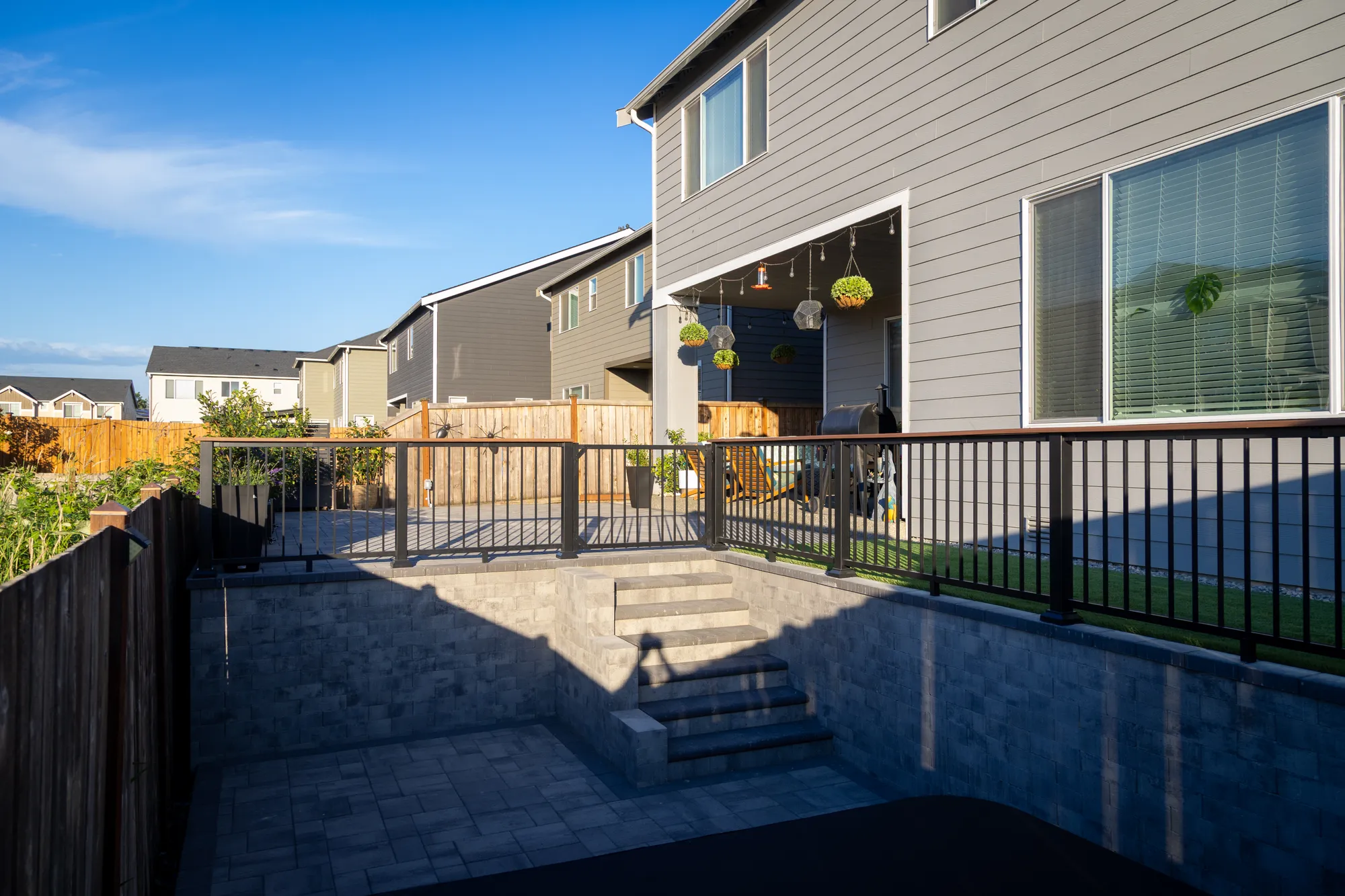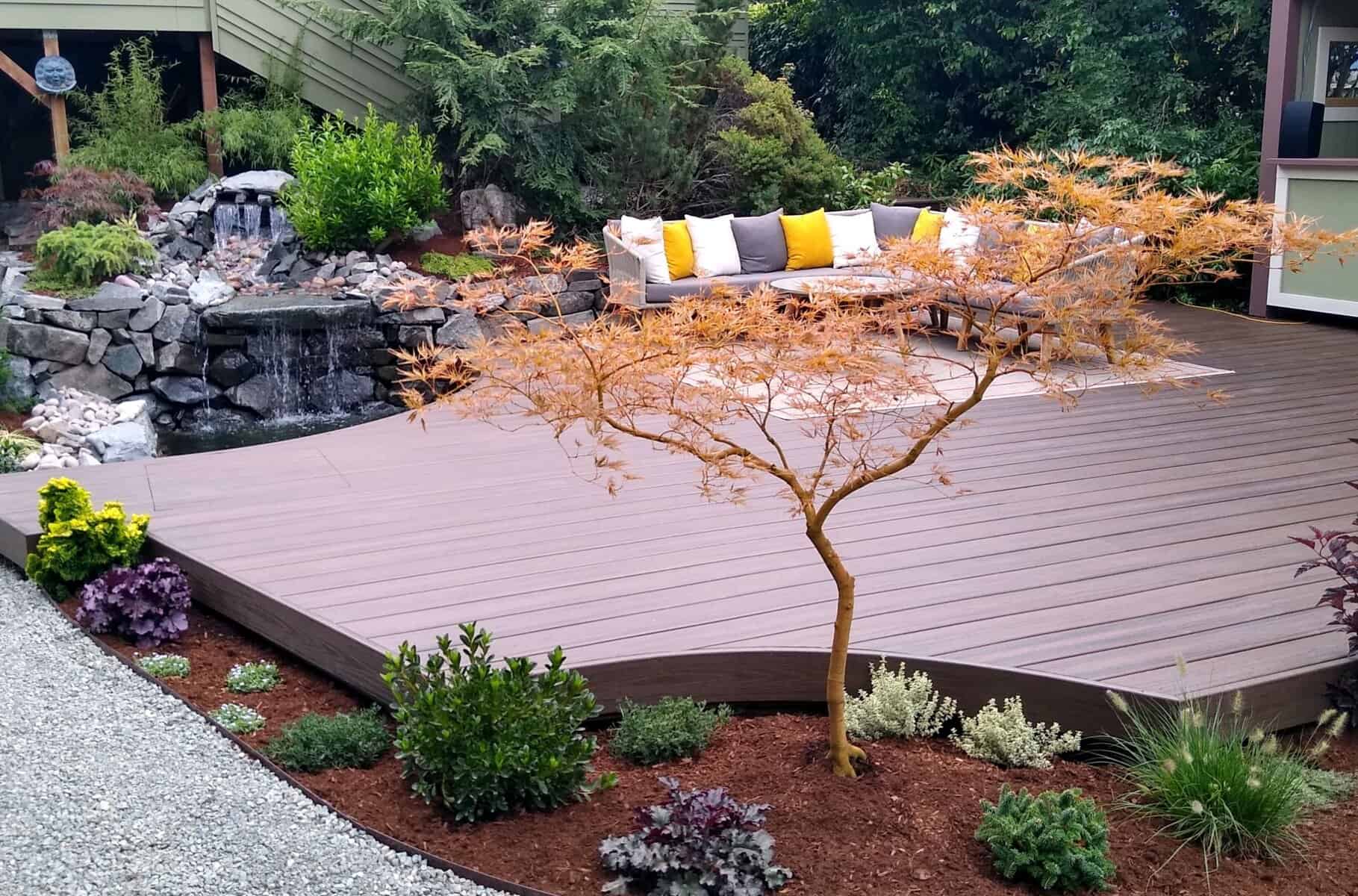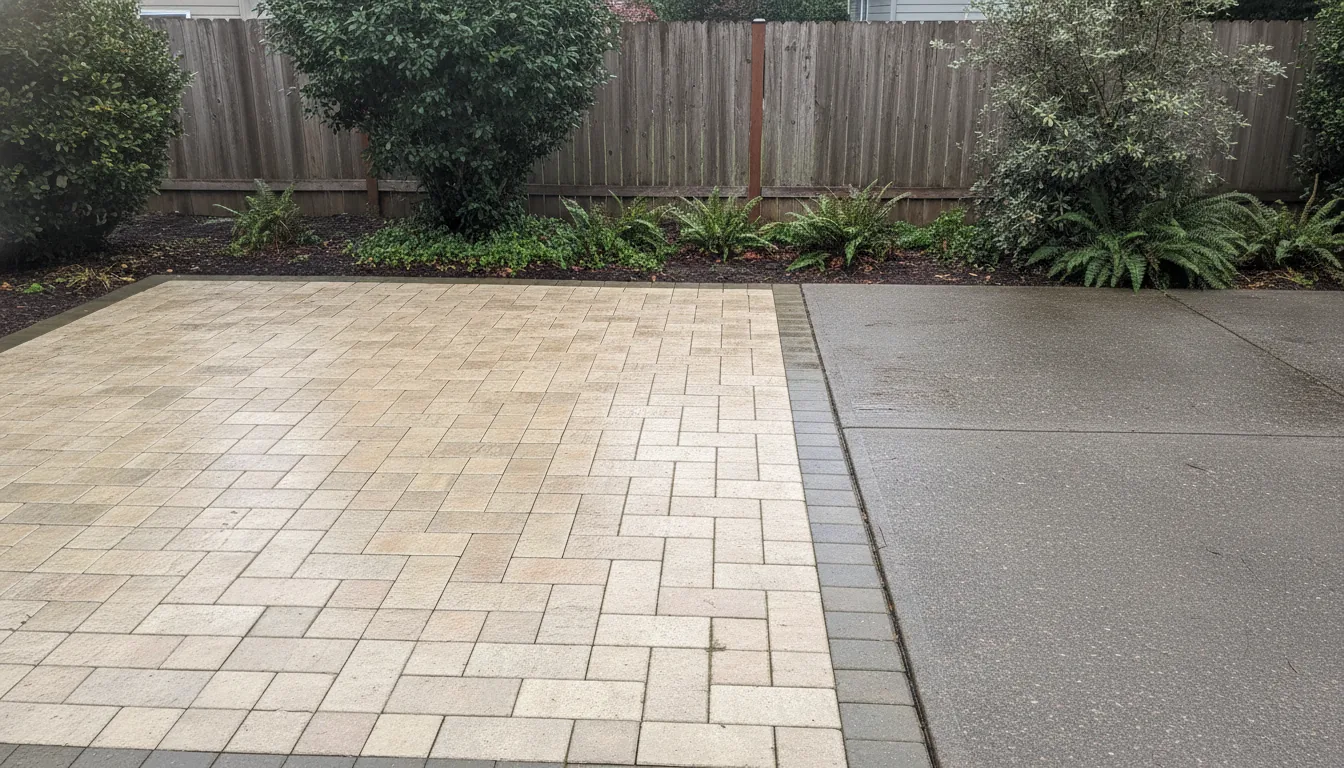
Pavers win on durability, repairability, and how well they hold up to a wet Pacific Northwest winter. Concrete wins on upfront cost and how fast it goes in. That is the honest version of the pavers vs concrete patio debate, and after building outdoor living spaces across Tacoma and Gig Harbor since 2006, I have watched both materials succeed and both fail. What decides the outcome is almost always fit: whether the material matched the yard, the budget, and how long the homeowner planned to enjoy the space.
Neither one is right for every yard. One of them is probably right for yours, and this guide will help you tell which.
Quick Takeaways
- Pavers typically outlast a concrete slab by decades and cost far less to repair when something cracks or shifts.
- Concrete makes real sense for large, flat, utilitarian spaces on a tight budget and a short timeline.
- Tacoma’s rain and freeze-thaw swings are hard on a rigid slab and forgiving to an interlocking paver surface.
- Judge a patio by its ten-year cost, not its installation price alone.
- Permeable pavers are the strongest drainage answer for a South Sound yard that sheds water toward the house.
- A paver patio that still looks sharp at year fifteen starts with the base, not the stone.
- Always compare itemized quotes. A single number with no breakdown hides where the corners got cut.
What the Pavers vs Concrete Debate Actually Comes Down To
A paver patio is built from individual paving stones set over a compacted crushed-stone base and a layer of setting sand, then locked together with polymeric sand in the joints. A concrete patio is poured as one continuous slab that cures into a single rigid surface. Those are two different construction philosophies, and the difference drives everything downstream: cost, repairability, and how each surface behaves under years of Western Washington weather.
The mistake I see most often is treating this as a simple price comparison. A poured slab costs less per square foot on day one, and a lot of homeowners stop reading right there. The comparison that actually matters is the total cost over twenty or thirty years, including the repair bill when the ground moves and something has to be fixed.
Your goals matter more than any single cost-per-square-foot figure. When a homeowner wants a low-maintenance patio around a pool deck they never have to think about again, I usually steer them toward concrete pavers, and those are the installs I rarely get a callback on. When the priority is the lowest possible upfront number on a big flat pad, concrete earns a real look.
How Pavers and Concrete Differ in Looks and Design Flexibility
Pavers give you design range a poured slab cannot match. You can mix patterns, set a contrasting border course, vary the joint lines, and combine concrete pavers with natural stone in the same space. I have watched a plain rectangle of lawn turn into the part of the yard everyone gathers in, just from thoughtful pattern and material choices.
Stamped concrete is the usual counterargument, and it deserves a fair hearing. It presses a pattern into a wet slab to mimic stone or paving units, and it can look good when it is fresh. The difference shows up over time:
- Color: pavers hold their color for decades, while stamped concrete fades and usually wants resealing every two to three years.
- Texture: pavers carry natural unit-to-unit variation, where a stamp repeats.
- Repairs: a swapped paver blends back in, while a patched slab rarely matches.
- Flexibility: pavers can be lifted and reset into a new layout, where a stamped slab is permanent once it cures.
Both age, but they age differently. A slab develops surface cracks as the ground shifts and sun works on the top layer. Pavers, being individual units on a flexible base, move slightly with the soil instead of cracking across the whole surface. A well-built paver patio at the fifteen-year mark still reads as intentional.
Which Material Holds Up Better in the Pacific Northwest
Our wet winters are where pavers pull decisively ahead of concrete. The Sea-Tac reference station has averaged about 38 inches of rain a year, most of it falling between October and March, and that water has to go somewhere. When it pools under a patio, it softens the soil underneath, and whatever sits on top starts to shift, settle, or crack. Drainage is the single biggest factor I weigh when a homeowner is choosing between pavers and concrete.
Pavers handle our freeze-thaw swings because they are not locked into one rigid plane. Each unit sits on a flexible base of crushed stone and setting sand, so the ground can move a little through a wet winter without destroying the surface above it. I have inspected paver patios around University Place after a hard, wet winter and found nothing worse than minor re-leveling.
A poured slab does not get that flexibility. Concrete expands and contracts with temperature swings, and control joints only manage so much of it. Once water works into a hairline crack and freezes, the gap widens fast, and fixing that frost damage properly is neither cheap nor quick. I have walked plenty of budget slabs around Puyallup and Gig Harbor that looked fine on day one and were failing by year two, purely because drainage was an afterthought.
Permeable pavers are the strongest drainage tool in the kit. They let rainwater filter down through the joints into a stone reservoir instead of sheeting toward the storm drain. The EPA lists permeable pavement among the green-infrastructure practices that cut runoff, which matters across a Puget Sound watershed and in Pierce County, where the county takes stormwater seriously. On a lot that slopes toward the house or sits near a drainage-sensitive area, permeable pavers are usually where I start, and the cost difference over standard concrete pavers is smaller than most people expect.
What Pavers and Concrete Cost to Install
A paver patio costs more to install than a poured slab, and that gap is real. In the South Sound, a paver patio generally runs about $15 to $35 per square foot installed, depending on the paver, the site, and the drainage work. A basic concrete paver sits at the low end; natural stone and custom patterns climb from there. A poured or stamped concrete patio runs roughly $8 to $18 per square foot, because it installs faster and the base work is simpler.
These are South Sound planning ranges anchored to 2026 cost data and adjusted for our labor and soil, not a quote for your yard. Our regional numbers sit above the national average for a reason: the same wet winters and clay-heavy soils that keep Western Washington green also demand deeper base work and real drainage.
Concrete is the smarter budget choice in specific situations, and I will say so plainly. If your number is firm, your timeline is short, and you are covering a large flat area with no curves or complex patterns, a poured slab gives you a functional, durable surface at a lower entry cost. It also goes in faster, which matters when our weather windows are tight. Concrete is the right call for plenty of projects; it just gets chosen for more of them than it should.
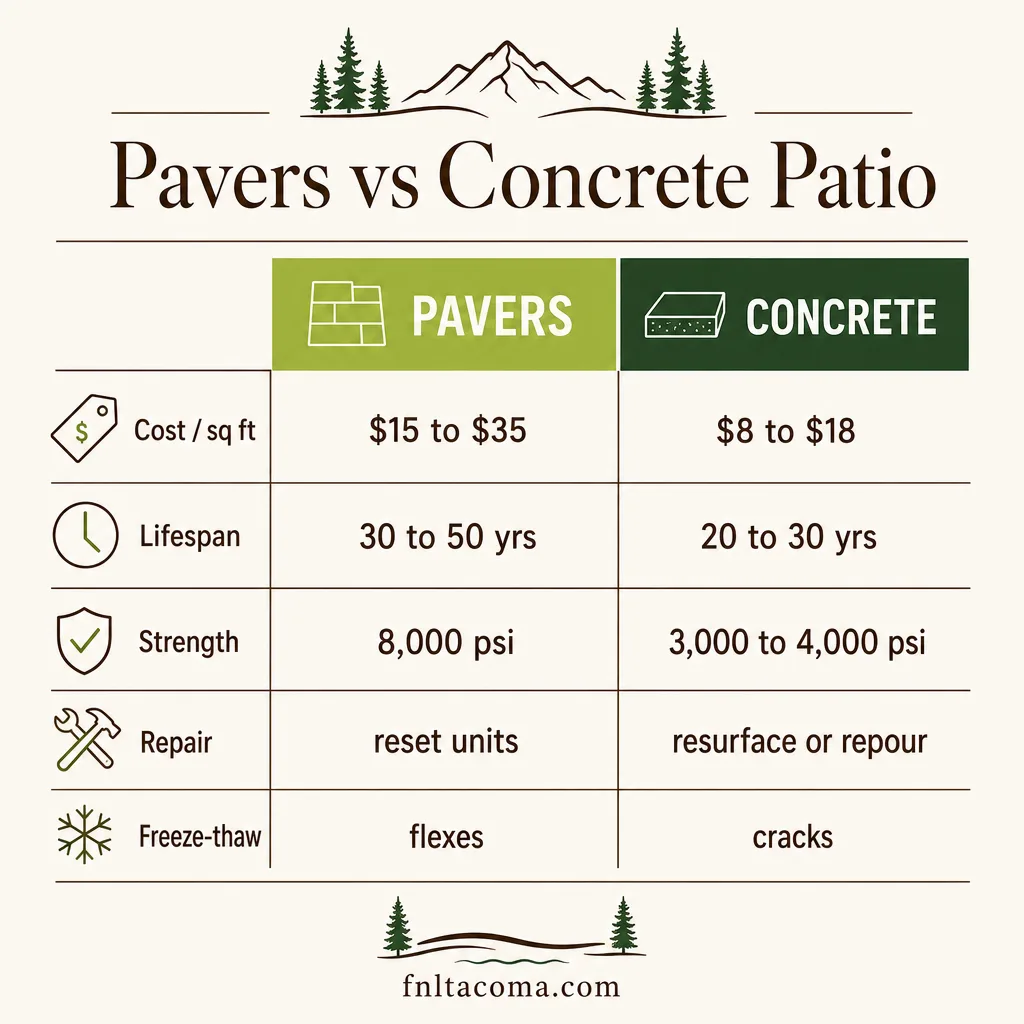
How Pavers and Concrete Compare, Side by Side
| Factor | Paver patio | Concrete patio |
|---|---|---|
| Installed cost per sq ft | $15 to $35 | $8 to $18 |
| Typical lifespan | 30 to 50 years | 20 to 30 years |
| Compressive strength | 8,000 psi minimum (ASTM C936) | typically 3,000 to 4,000 psi |
| Repair when it fails | Lift and reset individual units | Resurface (~$3 to $7/sq ft) or tear out and repour |
| Freeze-thaw performance | Flexes with ground movement | Rigid slab prone to cracking |
| Drainage | Permeable options available | Surface runoff only |
| Maintenance | Refresh joint sand, occasional seal | Reseal or crack-seal periodically |
| Design flexibility | Patterns, borders, colors, resettable | Uniform; stamping mimics but is fixed |
The strength line is worth a beat. Concrete pavers have to meet ASTM C936’s minimum average of 8,000 psi, several times the 3,000 to 4,000 psi typical of a residential concrete slab. That margin is part of why an interlocking surface shrugs off years of heavy foot traffic where a slab eventually shows its wear.
How Each One Performs When Something Goes Wrong
The repair story is where the long-term math turns. When a slab cracks, your options are resurfacing or replacement. Resurfacing a sound slab runs about $3 to $7 per square foot, but it is a cosmetic fix that does not touch whatever caused the crack, whether that was frost, a rushed base, or shifting soil. Tearing out and repouring costs more still, because you are paying for demolition plus a fresh slab.
A paver repair works differently. When a tree root lifts a couple of units along a path, we pull those pavers, deal with the root, re-level the base, and reset the stones with fresh joint sand. It is an afternoon of work, and the repair disappears within a season. You fix the small thing instead of replacing the whole surface.
Over ten years, that difference adds up. I have seen a homeowner spend more chasing repairs on a five-year-old slab than a paver patio would have cost to build right the first time. Durability has a dollar figure attached, and on a wet-climate patio it usually favors pavers.
When Concrete Is the Better Choice
Three situations where I will point a homeowner toward concrete:
- Large, flat, simple areas. With no curves, no grade changes, and no pattern work, a poured slab goes in faster and costs less per square foot than a comparable paver install.
- Spaces that want one continuous surface. A wide utility pad, a workshop approach, or a base that will live under a cover or pergola often benefits from one unbroken slab. For a clean pad under a new structure where speed and simplicity matter most, concrete delivers exactly that.
- Firm budgets on a short clock. Sometimes the number is the number, and I respect that. A correctly built slab, with proper base prep and control joints, gives you a durable surface now and leaves the door open to set pavers over it later.
Matching the Patio to How You Actually Use the Yard
If your yard hosts regular gatherings, a paver surface handles heavy foot traffic better over the long run, thanks to that 8,000 psi unit strength and joints that stay put. For pool decks and fire-pit areas, slip resistance is non-negotiable, and textured pavers and thermal flagstone grip far better than a smooth or stamped concrete surface when wet. When a stamped pool deck turns slick every summer, a textured paver surface is the fix I reach for.
A patio also should not sit in isolation. The best outdoor spaces tie the patio into the walkways, planting beds, and lawn through consistent materials, and pavers transition into a stone border or a permeable drainage zone far more naturally than a fixed slab does.
| Your priority | Better fit | Why |
|---|---|---|
| Lowest upfront cost | Concrete | Faster install, simpler base, lower labor |
| Long-term durability | Pavers | 30 to 50 year lifespan, unit-level repairs |
| Pool deck or wet areas | Textured pavers / thermal flagstone | Grip when wet |
| Heavy entertaining traffic | Concrete pavers | 8,000 psi handles steady use |
| Drainage and runoff control | Permeable pavers | Filters water through the base |
| Large flat utility space | Concrete | Seamless and cost-effective at scale |
| Freeze-thaw resilience | Pavers | Flexible base absorbs ground movement |
| Quick turnaround | Concrete | Pours and cures faster than a full paver install |
How We Build Patios That Last Here
I do not quote a patio off the hip. The right material and the real number depend on your soil, your slope, your access, and how water moves across your lot, and none of that shows up in a photo. So we start with a site walk: I look at the grade, the drainage, and the access, then put a detailed written estimate in front of you. From there we work on a time-and-materials basis, so you pay for the actual hours and materials the job takes rather than a padded guess.
Father Nature leads the design and self-performs the build with our own licensed and insured crew, start to finish, so the base and drainage details that decide whether a patio lasts do not get handed off to whoever is cheapest that week. Depending on your yard, we typically work in concrete pavers for high-traffic spaces, thermal flagstone for slip resistance around water, natural stone where the look calls for it, and permeable pavers where drainage leads. Every recommendation starts with your yard, not a catalog.
Father Nature Landscapes has been building outdoor spaces across Tacoma, Gig Harbor, Puyallup, and University Place since 2006. We carry more than 200 five-star reviews across Google, Yelp, and Angie’s List, an A-plus rating with the Better Business Bureau, and a feature on HGTV.
If you want a straight answer on which surface fits your yard, request a site walk or call us at 253-761-6437. We will look at your space, walk you through the options, and give you an honest recommendation built around your project.
Frequently Asked Questions
Is a paver patio worth the higher upfront cost?
Usually, yes. Pavers tend to outlast a concrete slab by decades, and you lift and reset a damaged unit instead of patching or repouring the whole surface, which keeps long-term repair costs low. The higher install number buys lower lifetime cost in a wet, freeze-thaw climate.
How do pavers hold up through freeze-thaw cycles here?
Dry-set pavers sit on a crushed-stone base that flexes with seasonal ground movement rather than cracking under it. That flexibility is the main reason pavers outperform a rigid slab through a Pacific Northwest winter.
Can I install pavers over an existing concrete slab?
Sometimes. A mortared installation over a sound, well-drained slab can work, but dry-set pavers need proper base prep and geotextile fabric underneath for long-term stability. The condition of the existing slab decides which approach makes sense.
Does my soil affect which patio material I should choose?
A lot. Clay soil, common across Tacoma and Gig Harbor, drains slowly and shifts with moisture, which stresses a rigid slab. Pavers on a properly built base absorb that movement far better over time.
What is the most slip-resistant patio material for a pool deck?
Textured pavers and thermal flagstone offer the best grip when wet, which is why I steer pool-deck and water-feature projects toward them over smooth or stamped concrete.
How long does a professionally installed paver patio last?
A paver patio on a solid base typically lasts 30 to 50 years or more. The lifespan rides on base prep, drainage, and how well the build planned for freeze-thaw conditions under the surface.
Do I need geotextile fabric under my paver base?
On most installs, yes. Geotextile fabric separates the base aggregate from the native soil so the two do not mix over time. Skipping it is one of the more common shortcuts that leads to premature settling.
Should I seal my paver patio?
Sealing is not always required, but it helps with staining, weeds in the joints, and color fade from sun. I usually recommend it for natural stone and lighter concrete pavers, and in our climate staying ahead of moss and joint washout is what keeps a patio looking new.
Sources
- ASTM C936 Standard Specification for Solid Concrete Interlocking Paving Units
- Concrete Network, Compressive Strength of Concrete (PSI)
- Angi, Paver Patio Cost 2026 Data
- Angi, Stamped Concrete Cost 2026 Data
- Angi, Concrete Resurfacing Cost 2026 Data
- EPA Soak Up the Rain, Benefits of Green Infrastructure
- NOAA / WRCC Sea-Tac Precipitation Climate Summary