You have spent an afternoon pricing a paver patio and every page hands you a different number. That is the part that wears people down. You want a figure you can actually plan around, not another range wide enough to lose a weekend in.
Here is the honest starting point. A paver patio in the Puget Sound runs about $15 to $35 per square foot installed, anchored to 2026 national paver patio cost data and adjusted for our labor rates and soil. For a typical 300-square-foot patio, that puts most South Sound projects somewhere between $5,000 and $10,500 before drainage work or upgrades. A basic concrete paver sits at the lower end. Natural stone, custom patterns, and proper Pacific Northwest drainage push it higher.
I have been building outdoor spaces across Tacoma, Gig Harbor, and Puyallup since 2006, and the cost that surprises people is almost never the paver. It is what goes underneath the paver.
Let me break down every cost driver so you can budget with real numbers, not guesswork.
Quick Takeaways
- Paver patio cost in the Puget Sound runs $15 to $35 per square foot installed, depending on material, site conditions, and drainage. Plan toward the middle, not the low end.
- The base and drainage under the pavers drive both the cost and the lifespan more than the paver material you choose.
- Drainage is not optional in the Pacific Northwest. Skipping it is the fastest way to a failing patio.
- Ground-level paver patios in Tacoma and Pierce County do not require a building permit. Any covered structure does.
- Concrete pavers meet ASTM C936 at a minimum 8,000 psi, which is why they outlast a poured slab through our freeze-and-thaw winters.
- Phasing a larger project across two seasons gets you a premium result without stretching the budget all at once.
- Always ask for an itemized quote. A single number with no breakdown is a red flag, not a deal.
What a Paver Patio Costs Right Now
Most paver patios in the South Sound land between $15 and $35 per square foot fully installed. Plan toward the middle of that range, not the bottom. The low end is a best case: a flat, square, easy-access yard with a basic concrete paver. Site conditions, drainage planning, and our labor rates pull a real project toward the top of that spread.
Size is the first lever. A 200-square-foot patio and a 500-square-foot patio use the same crew and the same site-prep process, but the material bill roughly doubles. Larger projects earn a slightly lower cost per square foot, and the total number always climbs.
Our regional pricing sits above the national average. The same wet winters and clay-heavy soils that keep Western Washington green also demand deeper base work and real drainage. A national cost guide written for a dry climate skips the exact work that keeps a patio flat through a Tacoma February, so a national estimate can land a few thousand dollars under your actual South Sound quote on a mid-size project.
Four Factors That Move Your Paver Patio Cost
Size and square footage
Size is the single biggest lever on the total. The crew, the equipment, and the prep are similar across sizes, but the material bill scales directly with the area. A bigger patio earns a slightly better per-square-foot rate and still costs more overall.
Material choice
Concrete pavers sit at the budget-friendly end. Natural stone and specialty materials cost considerably more, both in material price and in the labor to cut and fit them. Moving from concrete to all-natural stone can shift a standard patio by several thousand dollars.
Site, slope, and soil
A flat, accessible backyard on stable soil is the best case. Sloped lots need extra grading and sometimes a retaining element, and the clay-heavy soil common across Tacoma and Gig Harbor needs a deeper aggregate base to prevent long-term settling.
Pattern complexity and features
A simple running-bond pattern installs faster than a herringbone or a custom multidirectional layout. Complex patterns mean more cutting, more waste, and more labor hours. Fire pits, built-in seat walls, patio extensions, and lighting are each beautiful, and each one adds a real line to the final quote.
Paver Materials and What Each One Costs
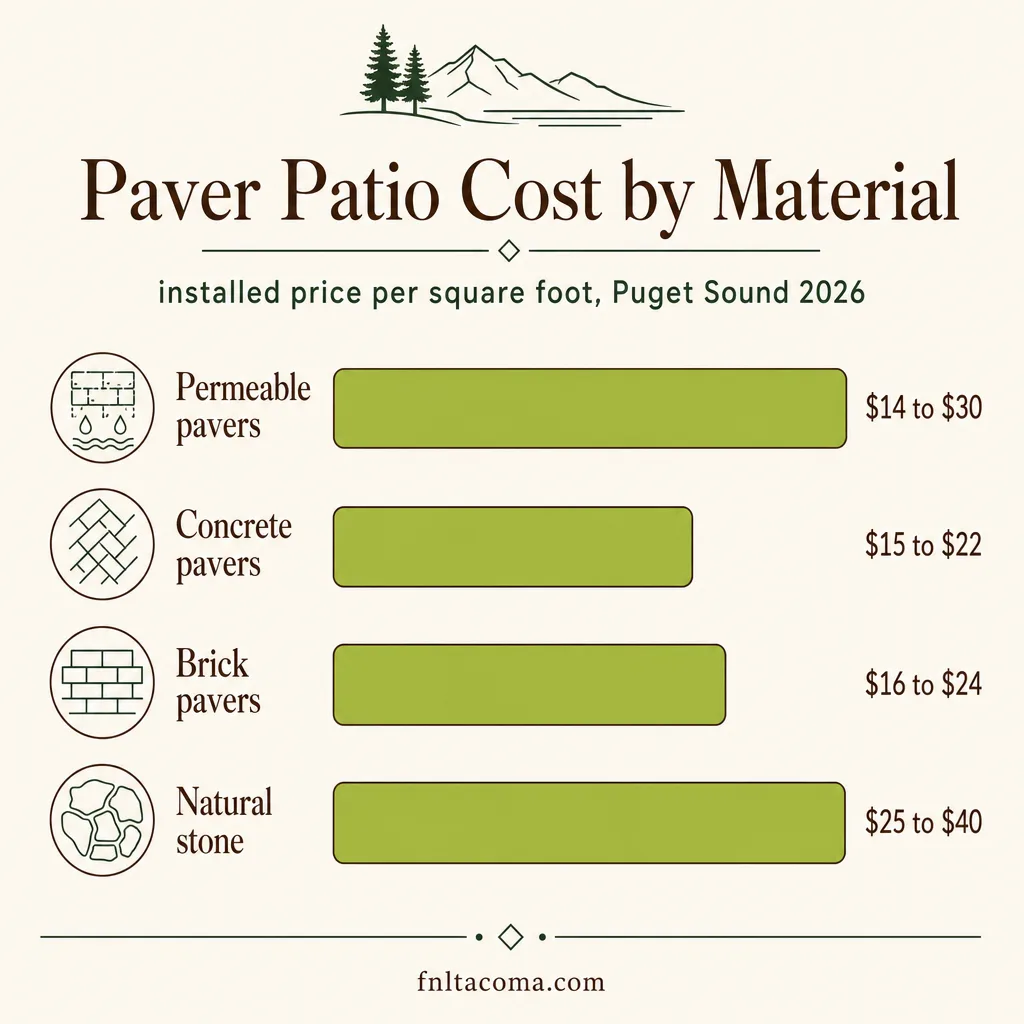
Concrete pavers are the most popular choice I install across the South Sound. They come in a wide range of shapes and colors, they meet ASTM C936, which requires a minimum average compressive strength of 8,000 psi, and they deliver a premium look at a manageable price. Expect roughly $15 to $22 per square foot installed for a standard sand-set concrete paver patio here.
Brick pavers bring a classic warmth that suits the older craftsman homes across North Tacoma and Gig Harbor. They run a little higher, around $16 to $24 per square foot installed, and the joints want periodic attention to keep moss out in our wet climate. Sealed and set on a proper base, they age beautifully and hold their slip resistance.
Natural stone sits at the premium end, generally $25 to $40 per square foot installed depending on the stone, the sourcing, and how much cutting your design demands. The durability and the visual richness make it a serious option for a forever-home patio where the budget has room.
Permeable pavers have open joints that let rainwater drain through the surface instead of running off. In our climate that is a real advantage, and the EPA lists permeable pavement among the green-infrastructure practices that cut runoff and protect the base layer. Installed cost runs about $14 to $30 per square foot depending on the system and the site.
These are market ranges for the South Sound, anchored to 2026 national paver cost data and adjusted for our labor and soil conditions. They are planning numbers, not a quote.
| Material type | Installed cost / sq ft | Durability | Maintenance | Best for |
|---|---|---|---|---|
| Concrete pavers | $15 to $22 | High | Low | Most South Sound patios; design variety at a fair price |
| Brick pavers | $16 to $24 | High | Medium | Classic look, older craftsman-style homes |
| Natural stone | $25 to $40+ | Very high | Low | Premium, forever-home outdoor spaces |
| Permeable pavers | $14 to $30 | High | Low | Sloped or drainage-sensitive lots |
| Stamped concrete (alternative) | $8 to $18 | Medium | Medium | Lower up-front budget; not a paver |
Why Base Prep and Drainage Are the Real Cost
Drainage is not optional in the Pacific Northwest. The Sea-Tac reference station has averaged about 38 inches of rain a year, most of it falling between October and March, and that water has to go somewhere. When a patio is set without drainage planning, water saturates the base, and the pavers shift and settle within a few seasons.
I have walked plenty of budget installs around Puyallup and Gig Harbor that looked fine on day one and were failing by year two, purely because drainage was an afterthought.
A base built to last in our climate involves real steps, none of which show once the patio is finished:
- Excavation to the correct depth for the soil and the load
- A compacted crushed-gravel sub-base, usually four to six inches deep
- A geotextile fabric to separate the soil from the aggregate
- A bedding-sand layer for final leveling before the pavers go down
That hidden work is exactly the first thing a cheap quote cuts. It is also the difference between a patio that holds for decades and one that needs attention in five years.
Permeable pavers are worth a serious look when a lot slopes toward the house or sits near a drainage-sensitive area. They send rainwater into a stone reservoir underneath instead of sheeting it toward the storm drain, and the cost difference over standard pavers is smaller than most people expect.
Pavers vs. a Poured Concrete Patio
On day one, a paver patio costs more than poured concrete. Over the life of the patio, that math usually flips.
A poured or stamped concrete patio in our area runs roughly $8 to $18 per square foot, real money saved up front. On a 300-square-foot patio you are looking at a few thousand dollars more for pavers. Then our freeze-and-thaw cycles go to work on the slab, and a rigid surface cracks where the ground moves.
Pavers meet that ASTM C936 minimum of 8,000 psi, several times the compressive strength of a typical residential concrete slab, and an interlocking surface flexes slightly with seasonal ground movement instead of cracking. The repair story is the quiet advantage. When a paver is damaged, we lift those few units and reset replacements in an afternoon, and the surface looks untouched. A cracked slab gives you a patch that never quite matches, or a teardown.
Permits and the Costs That Hide in a Cheap Quote
The good news for most homeowners: a ground-level paver patio does not require a building permit in Tacoma or Pierce County, since a patio on grade is not a structure. That changes the moment you add a cover, a raised platform, or anything attached to the house. Pierce County’s guidance is clear that a cover over a patio or deck needs a full building permit and must meet setback requirements.
Larger hard-surface projects can also trigger a stormwater review. Tacoma and Pierce County fall under Washington’s Phase I Municipal Stormwater Permit, which runs through July 2029. Most standard residential patios fall below the review threshold, but it is always worth confirming with your contractor before work begins.
The costs that ambush people are the ones a budget quote leaves off the page:
| Cost item | Estimated cost | When it applies |
|---|---|---|
| Demolition of an existing patio | $2 to $6 per sq ft | When you are removing an old surface |
| Excavation, gravel sub-base | part of base prep | Almost always |
| Geotextile fabric and bedding sand | $0.10 to $1 per sq ft | Yes |
| Paver sealing | about $200 per 1,000 sq ft | Strongly recommended |
| Permit (covered structures only) | $150 to $750 | Only with a cover or attachment |
| Drainage materials and labor | varies by site | Strongly recommended |
Mortar-set material runs to the top of the demolition range because it has to be chipped out rather than lifted. None of the rest of that list is optional on a Puget Sound install. When you compare bids, ask every contractor the same question: are demolition, base prep, drainage, and sealing itemized, or bundled into one vague number? If a contractor hands you a single figure with no breakdown, ask for the line items before you go any further.
Stretching the Budget Without Cutting Corners
You can save money on a paver patio. You just have to save it in the right places.
Choosing the right material matters more than going premium everywhere. A quality concrete paver delivers a clean, lasting look at a fraction of natural-stone cost, and a simple running-bond pattern costs less in labor than an intricate one without reading as a compromise. I always walk clients through a cost-versus-impact comparison before we lock a design, because a straightforward layout in a strong paver can look just as sharp as a complicated one.
Phasing is the other smart move. Build the core patio and its full base in the first phase, then add extensions, a seat wall, or lighting in a second phase once the budget allows. The key is building that first phase to full specification so the foundation supports everything that comes later without rework.
A well-built paver patio is a lasting asset to your property and your daily life. I keep the focus on getting it done right the first time rather than on chasing a percentage at resale, because what you are really buying is decades of Saturday mornings spent on the patio instead of stressing about the yard.
How I Price a Puget Sound Paver Patio
I do not quote a patio off the hip. The number depends on your soil, your slope, your access, and what is already in the ground, and none of that is visible from a photo. So we start with a site walk. I look at the grade, the drainage, the access, and the condition of whatever is there, then put a detailed written estimate in front of you.
From there we work on a time-and-materials basis, so you pay for the actual hours and materials the job takes rather than a padded guess. Every estimate is itemized, with base prep, drainage, materials, and sealing broken out, so you can see exactly what you are paying for and why. Father Nature leads the design and self-performs the build with our own licensed and insured crew, start to finish, so the work does not get handed off to whoever is cheapest that week.
Father Nature Landscapes has been building outdoor spaces across Tacoma, Gig Harbor, Puyallup, and University Place since 2006. We carry more than 200 five-star reviews across Google, Yelp, and Angie’s List, an A-plus rating with the Better Business Bureau, and a feature on HGTV. The base and drainage details that other crews skip are the ones we treat as non-negotiable, because they are what decide whether your patio is still flat in fifteen years.
If you want a clear, honest number for your specific patio, book a site walk with our team or call us at 253-761-6437. We will look at your yard, walk you through your paver options, and give you a real estimate built around your project.
Frequently Asked Questions
How does paver patio cost compare to a concrete patio?
A poured or stamped concrete patio generally runs $8 to $18 per square foot installed, while a paver patio starts higher at roughly $15 per square foot and climbs with material and site conditions. Pavers cost more up front and tend to last longer with simpler repairs, since a damaged unit gets reset rather than the whole surface being patched or resurfaced.
Can I add patio lighting later without a big cost jump?
Yes. Path lighting, accent lighting, and patio lighting are some of the easiest elements to phase into a second stage after the core patio is built. Planning the layout or running conduit during the first phase keeps that later addition clean and affordable.
Do paver patios hold up to Pacific Northwest moisture and storms?
Properly installed pavers with a compacted base and sealed joints handle our wet winters well. The interlocking surface flexes slightly with ground movement, which is more forgiving than a rigid concrete slab during heavy freeze-and-thaw stretches.
Do I need a permit for a paver patio in Tacoma, including for an ADU?
A ground-level paver patio does not require a building permit in Tacoma or Pierce County. A covered patio structure, or one attached to a house, an ADU, or a DADU, does require a permit and must meet Pierce County setback requirements.
Are slip resistance and pool decks a concern with pavers here?
Slip resistance matters on any surface that stays wet for months, and it is a real consideration around a pool deck. Textured paver finishes are designed with grip built into the surface, which is why I steer pool-deck and walkway projects toward them.
Is a paver patio a better investment than a deck?
It depends on your grade, your lifestyle, and your budget. Paver patios usually carry lower long-term maintenance, while a deck makes more sense for an elevated space or a spot where the ground falls away from the house. Both can be the right call; the site usually decides.
Can you combine a paver patio with artificial turf?
Yes, pairing a paver patio with a synthetic turf area is one of the more popular combinations we build. It gives a clean, low-maintenance result that works well for families across the South Sound.
How often should a paver patio be cleaned and sealed?
A gentle wash once a year keeps the surface looking sharp, and resealing every two to three years protects the joints and color depending on traffic and exposure. In our climate, staying ahead of moss and joint washout is what keeps a patio looking new.
Sources
- Angi, Paver Patio Cost 2026 Data
- Angi, Stamped Concrete Cost 2026 Data
- Angi, Paver Cleaning and Sealing Cost 2026
- HomeGuide, Paver Patio Installation Cost 2026
- ASTM C936 Standard Specification for Solid Concrete Interlocking Paving Units
- EPA Soak Up the Rain, Benefits of Green Infrastructure
- NOAA / WRCC Sea-Tac Precipitation Climate Summary
- Pierce County, Building and Permitting FAQ
- Washington Department of Ecology, Phase I Municipal Stormwater Permit