You have spent an hour pricing a paver driveway and every page hands you a different number. That is the part that wears people down. You want a figure you can plan around, not another range wide enough to drive a truck through.
Here is the honest starting point. A paver driveway in Tacoma runs about $10 to $30 per square foot installed, with most homeowners landing between $6,000 and $18,000 for a standard two-car driveway. Where you land inside that spread comes down to three things: the paver you pick, the ground underneath it, and how the wet-season drainage gets handled.
I have been building outdoor spaces in the South Sound since 2006, and the cost that surprises people is almost never the paver. It is what goes under the paver.
Let me break it down so you can budget with your eyes open.
Quick Takeaways
- Paver driveway cost in Tacoma runs $10 to $30 per square foot installed. Plan toward the middle of that range, not the low end.
- The base and drainage under the pavers drive both the cost and the lifespan more than the paver material you choose.
- Concrete pavers give most South Sound driveways the best balance of strength, cost, and longevity.
- A good quote itemizes demolition, drainage, edge restraints, and polymeric sand. A cheap quote hides them.
- Concrete pavers meet ASTM C936 at a minimum average 8,000 psi, which is why they carry vehicle weight without cracking the way a poured slab does.
- A paver driveway typically lasts 30 to 50 years, and a single cracked paver can be swapped without disturbing the rest.
- Book your design in late winter or early spring for easier scheduling and a finished driveway by the dry season.
What a Paver Driveway Costs in Tacoma Right Now
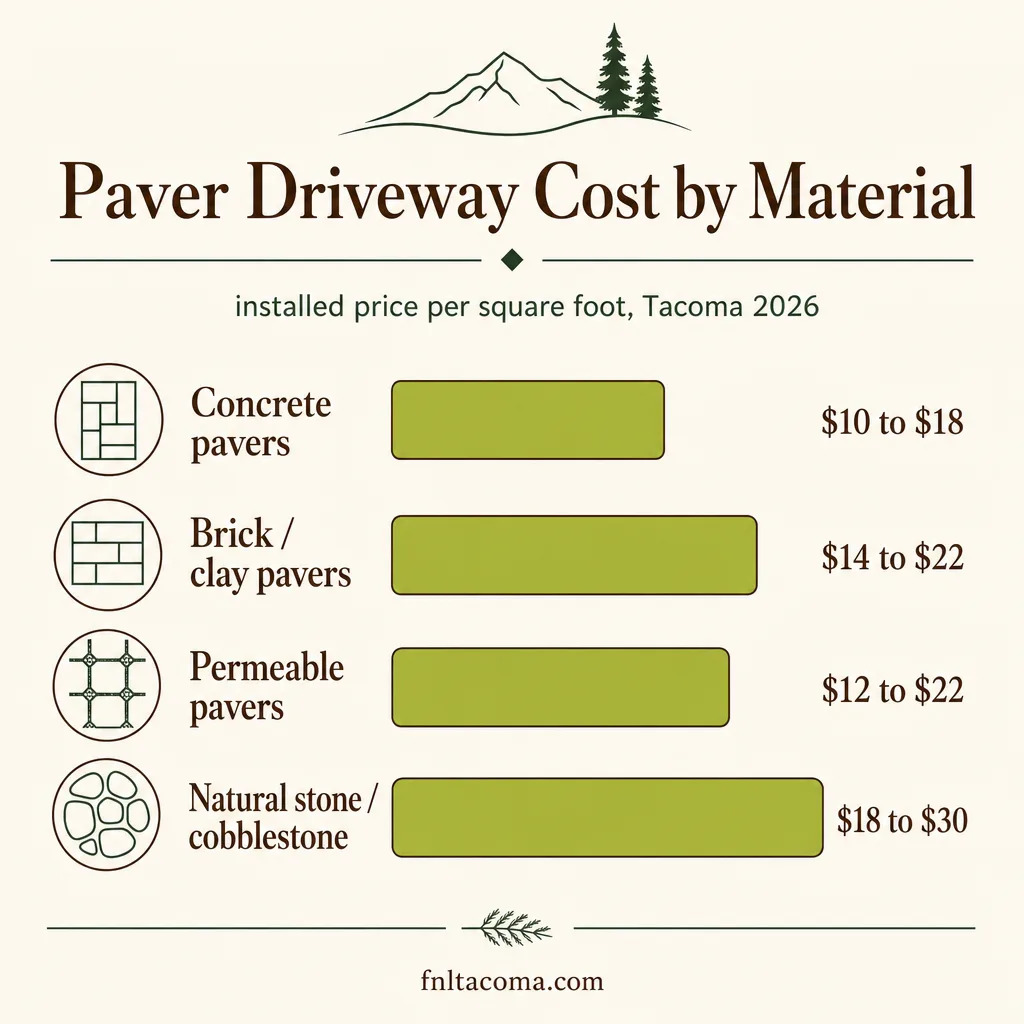
Plan toward the middle of the range, not the bottom. Most paver driveways in the South Sound come in between $10 and $30 per square foot fully installed. The low end is a best case for a flat, square, easy-access lot with a basic concrete paver. Build your budget around the middle and you will rarely get a bad surprise.
Size is the first lever. A single-car driveway covers roughly 200 to 300 square feet. A two-car driveway usually runs 400 to 600 square feet, which is where most Tacoma projects land. A longer approach or a turnaround pushes you past that.
Our regional pricing sits a little above the national average, for a reason. The same wet winters and clay-heavy soils that make Western Washington green also demand deeper base work and real drainage. A national cost guide written for a dry climate skips the exact work that keeps a driveway flat through a Tacoma February.
| Paver material | Installed cost per sq ft | Single-car (≈250 sq ft) | Two-car (≈500 sq ft) | Large (≈750 sq ft) |
|---|---|---|---|---|
| Concrete pavers | $10 to $18 | $2,500 to $4,500 | $5,000 to $9,000 | $7,500 to $13,500 |
| Brick / clay pavers | $14 to $22 | $3,500 to $5,500 | $7,000 to $11,000 | $10,500 to $16,500 |
| Natural stone / cobblestone | $18 to $30 | $4,500 to $7,500 | $9,000 to $15,000 | $13,500 to $22,500 |
| Permeable pavers | $12 to $22 | $3,000 to $5,500 | $6,000 to $11,000 | $9,000 to $16,500 |
These are market ranges for the South Sound, anchored to 2026 national paver driveway data and adjusted for our labor rates and soil conditions. They are planning numbers, not a quote. The only way to get a real figure for your driveway is to have someone walk the actual site.
Paver Materials and What Each One Costs
Concrete pavers are the most popular driveway paver I install across Tacoma and Gig Harbor, and for good reason. They meet ASTM C936, which requires a minimum average compressive strength of 8,000 psi, so they carry vehicle traffic without cracking the way a poured slab can. They are also the most budget-friendly path to a quality driveway, which is why I steer most homeowners toward them unless there is a specific reason to upgrade.
Clay and brick pavers bring a warmth that concrete cannot quite copy, and they hold their color for decades. The tradeoff is cost, since the material itself runs higher. A clay paver suits an older home where the look needs to feel like it has always been there.
Natural stone and cobblestone sit at the top of the range. They look the part, but they need more precise installation and a deeper, more carefully built base to carry vehicle load. I usually recommend stone for a short apron or an accent band rather than a full driveway where the budget has to stretch.
What Actually Drives the Price
The paver you pick sets the floor. Everything below the paver sets the ceiling.
Base preparation. This is where cheap jobs fail and where good ones spend their money. Excavation, grading, and a properly compacted gravel base can add several dollars per square foot before a single paver is set. On Tacoma clay, under standing winter moisture, a thin base is the most expensive mistake you can make, because you pay for it twice.
Drainage. In our climate, water management is the whole game. A driveway that sheds and infiltrates water correctly stays flat. One that traps water under the surface starts shifting and sinking within a season or two.
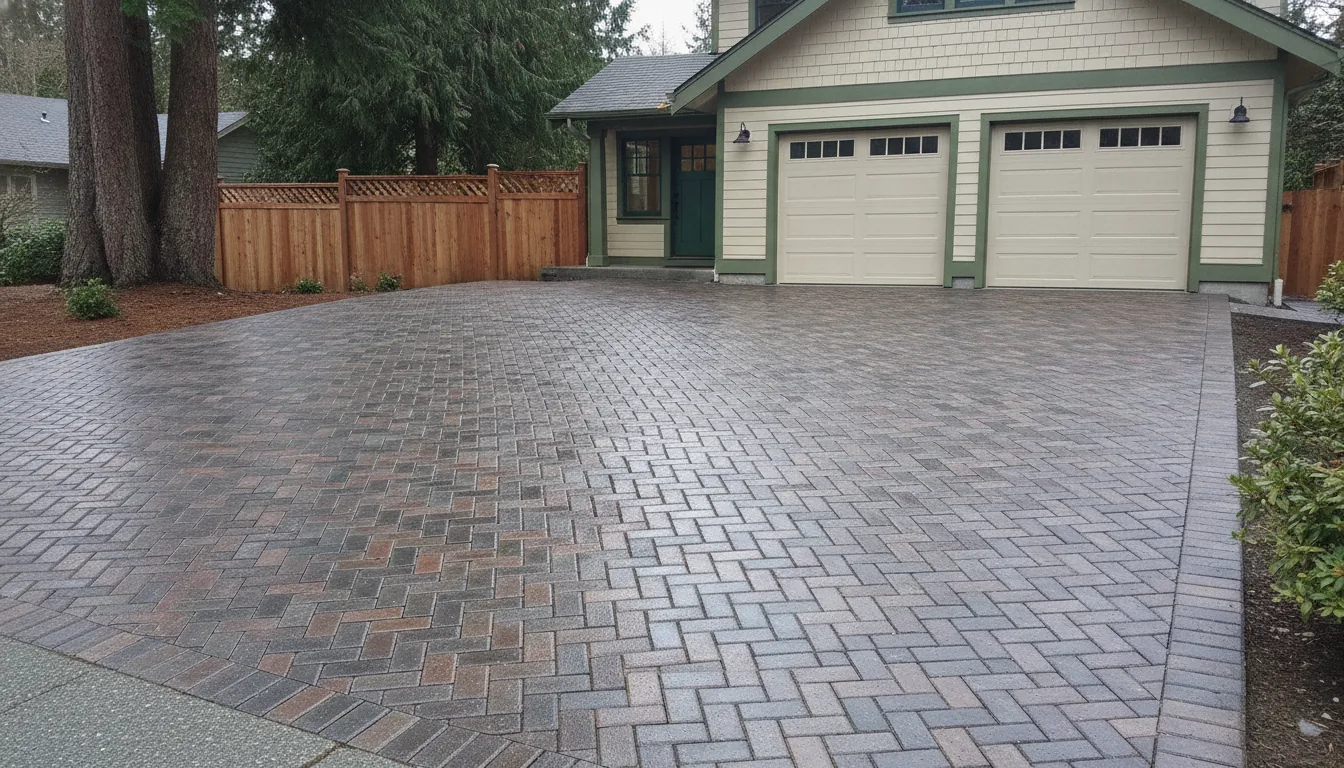
Size, shape, and pattern. A straight rectangle in standard concrete pavers is the most efficient layout there is. Curves, borders, and patterns like herringbone or basketweave look great, and they add labor hours and cut waste, which shows up in the per-square-foot price.
Slope and site access. Two driveways with identical square footage can cost very different amounts based on what the ground is doing. A slope needs extra grading and sometimes a retaining element. A tight, fenced lot a machine cannot reach means more hand labor.
Removing the old surface. If there is an existing concrete or asphalt driveway, tearing it out and hauling it off is its own line item, often a few dollars per square foot. On a 500-square-foot driveway that alone can run into four figures.
The Costs That Hide in a Cheap Quote
A low quote is usually a short quote. The dollars that protect your driveway are the ones a bargain bid leaves off the page.
Watch for these in any driveway quote:
- Demolition and haul-off of the old driveway, debris and dump fees included
- Permits. Pierce County requires a right-of-way permit where a new driveway approach connects to a county road, plus additional review when the work touches a critical area or drainage
- Edge restraints, which lock the pavers in so the edges do not creep and spread
- Polymeric sand in the joints, which keeps the surface tight and resists weeds and washout
- Drainage materials and labor
Decorative upgrades are the other place the number climbs. Border courses, contrasting inlays, and a larger-format paver can add real money on top of the base install. None of that is wrong to want. Just know it is optional, and separate from the structural work that makes the driveway last.
When you compare bids, ask every contractor the same question: are demolition, base prep, drainage, edge restraints, and polymeric sand itemized, or bundled and vague? Two quotes for the same driveway can look hundreds or thousands of dollars apart, and the gap is almost always in the work you cannot see once the job is done.
Pavers vs. Concrete, Asphalt, and Gravel
On day one, pavers cost more than the alternatives. Over thirty years, that math usually flips.
Gravel runs the least up front, then needs regrading and replenishing, and washes out in heavy rain. A poured or stamped concrete driveway runs roughly $8 to $18 per square foot, then cracks where our freeze-and-thaw cycles work on it. A paver driveway costs the most to install and tends to last the longest with the least drama.
| Category | Pavers | Stamped concrete | Asphalt | Gravel |
|---|---|---|---|---|
| Installed cost / sq ft | $10 to $30 | $8 to $18 | $3 to $7 | $1 to $3 |
| Typical lifespan | 30 to 50 years | 20 to 30 years | 15 to 25 years | 5 to 10 years |
| Maintenance | Low (joint sand, occasional seal) | Medium (crack sealing, resealing) | High (seal every 2 to 3 years) | High (regrading, replenishment) |
| Repairs | Lift and replace single pavers | Visible patches | Patches show | Add material |
| Heavy rain | Strong with proper drainage | Prone to cracking | Surface wear | Washout risk |
| Curb appeal | High | Medium to high | Low to medium | Low |
| Best for | South Sound homes built to last | Mid-range budgets | Budget installs | Rural or temporary use |
The reason pavers hold up here is that they flex. An interlocking paver surface lets the ground move a little with the seasons without cracking. A poured slab is rigid, so when the soil shifts, the slab cracks, and a cracked slab is a patch or a teardown.
Why Drainage Changes the Math in the Pacific Northwest
Rain is the single biggest reason a Tacoma driveway costs more than a Phoenix one, and it is worth the money. The Sea-Tac reference station has averaged about 38 inches of rain a year, and most of it falls between October and March. That sustained wet season does not sit on the surface. It works into any weak point in the base and finds the corners that were cut.
Permeable pavers are worth a look here. They let rainwater pass through the joints and soak into a stone reservoir underneath instead of sheeting toward the storm drain. The EPA lists permeable pavement among the green infrastructure practices that reduce runoff, which matters in a Puget Sound watershed. I point clients toward permeable pavers when a lot slopes toward the house or sits near a drainage-sensitive area, and the cost difference over standard concrete pavers is smaller than most people expect.
The stakes reach past your own driveway. The EPA finds that once impervious surfaces reach 10 to 20 percent of a local watershed, surface runoff doubles, and it keeps climbing from there. A single driveway is a small piece of that, but how it handles water is not a detail. It is the difference between a surface that lasts and one that fails.
This is also why base depth matters more here than the national guides admit. A typical guide calls for a four to six inch compacted base. On Tacoma clay, under vehicle load, I spec a deeper one. The added base is money you spend once so you do not pay for a reset later.
How to Save Money Without Cutting Corners
You can save money on a paver driveway. You just have to save it in the right places.
Timing helps. Late winter and early spring are slower months for hardscape crews in the South Sound, so scheduling is easier and crews are less stretched. Booking your design and planning in the off-season also means you are ready to build when the dry weather returns.
Spend the money where it does structural work:
- Base depth and a properly compacted gravel base
- Drainage, especially on clay soil or a sloped lot
- Edge restraints and polymeric sand for long-term joint stability
Pull back where the spending is cosmetic: oversized pavers, contrasting borders, and decorative inlays. They add curb appeal and they do not change whether the driveway holds up. If the budget is tight, a clean straight layout in a quality concrete paver is a driveway you will be glad you have for decades.
How Long a Paver Driveway Lasts and What Upkeep Costs
A well-built paver driveway lasts 30 to 50 years, which is roughly double a poured concrete slab. That number assumes the base was done right, the drainage works, and the joints get refreshed now and then. What shortens it is rushed base work, ignored joint sand, and tree roots nobody planned for. I have seen a beautiful driveway fail in under a decade because the base was hurried, and I have seen a modest one push forty years because the fundamentals were done right.
Upkeep is light. Plan on refilling polymeric sand in worn joints, an occasional cleaning, and a seal coat every few years if you want it. A few hundred dollars a year covers most driveways.
The repair story is the quiet advantage. When a delivery truck cracks a paver near the apron, we lift those few pavers and drop in replacements in an afternoon, and the surface looks untouched. A cracked concrete slab gives you a patch that never quite matches, or a teardown. Pavers let you fix the small thing instead of replacing the whole thing.
How I Price a Tacoma Paver Driveway
I do not quote a driveway off the hip. The number depends on your soil, your slope, your access, and what is under the existing surface, and none of that is visible from a photo. So we start with a site walk. I look at the grade, the drainage, the access, and the condition of what is already there, then put a detailed written estimate in front of you.
From there we work on a time-and-materials basis, so you pay for the actual hours and materials the job takes rather than a padded guess. Every estimate is itemized, with base prep, drainage, edge restraints, polymeric sand, and permits broken out, so you can see exactly what you are paying for and why.
Father Nature Landscapes has been building outdoor spaces across Tacoma, Gig Harbor, Puyallup, and University Place since 2006. We carry more than 200 five-star reviews across Google, Yelp, and Angie’s List, an A-plus rating with the Better Business Bureau, and a feature on HGTV. Driveways are some of the most demanding hardscape work we do, and the base and drainage details that other crews skip are the ones we treat as non-negotiable.
If you want a clear, honest number for your specific driveway, request a site walk or call us at 253-761-6437. We will look at your site, walk you through your paver options, and give you a real estimate built around your project.
Frequently Asked Questions
Does driveway shape affect the total cost?
Yes, and more than people expect. Curved layouts, irregular borders, and non-rectangular shapes need more paver cuts and more labor hours than a straight rectangle, so they raise the cost per square foot. A simple shape in a standard concrete paver is the most budget-friendly route to a quality driveway.
What paver pattern is best for a driveway?
For a surface carrying regular vehicle weight, I recommend herringbone or basketweave. Both interlock tightly and spread the load across more pavers than a running-bond pattern, which makes them more resistant to shifting under cars and trucks over time.
Are permeable pavers worth the extra cost in Tacoma?
Often, yes. Permeable pavers handle our wet season by letting water infiltrate instead of running off, which helps on sloped lots and near drainage-sensitive areas. The cost difference over standard concrete pavers is smaller than most people assume, and the drainage benefit is real in a rainy climate.
Do I need a permit for a paver driveway in Pierce County?
Sometimes. Pierce County generally requires a right-of-way permit where a new driveway approach connects to a county road, plus additional review when the work affects a critical area or drainage. A good contractor pulls the permits that apply rather than skipping them and hoping.
Are porcelain pavers a good choice for a driveway?
Porcelain pavers look striking, but they need careful selection for driveway use. You want a high-thickness, frost-resistant porcelain rated for vehicle load, and the installation calls for more precision than a standard concrete paver, which raises the cost.
What is a paver apron and do I need one?
A paver apron is the transition section between your driveway and the street or garage entrance. I include one on most driveways because it protects the edge, helps drainage flow, and gives the finished surface a clean, intentional look.
What are the long-term savings of pavers over concrete or asphalt?
The savings come from avoiding full replacement. When pavers are damaged, you replace the affected units instead of tearing out the whole surface, and a 30 to 50 year lifespan outlasts asphalt and standard concrete by a wide margin. The higher upfront number buys you decades of lower repair and replacement cost.
How much does a paver driveway add to my home’s value?
A well-built paver driveway adds real curb appeal and reads as a finished, cared-for home, especially when it ties into the rest of the landscape. I do not put a percentage on resale value, because that depends on your home, your block, and the market on the day you sell.
Sources
- Angi, Paver Driveway Cost 2026 Data
- Angi, Stamped Concrete Cost 2026 Data
- ASTM C936 Standard Specification for Solid Concrete Interlocking Paving Units
- EPA EnviroAtlas, Percent Impervious Area Fact Sheet
- EPA Soak Up the Rain, Benefits of Green Infrastructure
- NOAA / WRCC Sea-Tac Precipitation Climate Summary
- Pierce County, Right of Way and Permitting