It’s the second week of August. You’re dragging the hose across a lawn that crunches underfoot, the brown patch by the fence has grown since Sunday, and you’ve asked the neighbor’s kid to water while you’re at the lake for four days. Now picture that same week with the hose coiled up in the garage, the salal dark green in the shade, and your evening spent on the patio with a cold drink instead of standing over a sprinkler.
These eleven drought-resistant native plants are a good place to start if you want that August in a Pacific Northwest yard. Each plant has to go in the right spot, and we decide that when we plan the whole yard. A few of them are on here for a reason other than toughness in a dry spot, and I’ll tell you which.
Life+Land Lessons
- Tacoma’s normal rainfall for July and August adds up to 1.38 inches out of 40.81 a year.
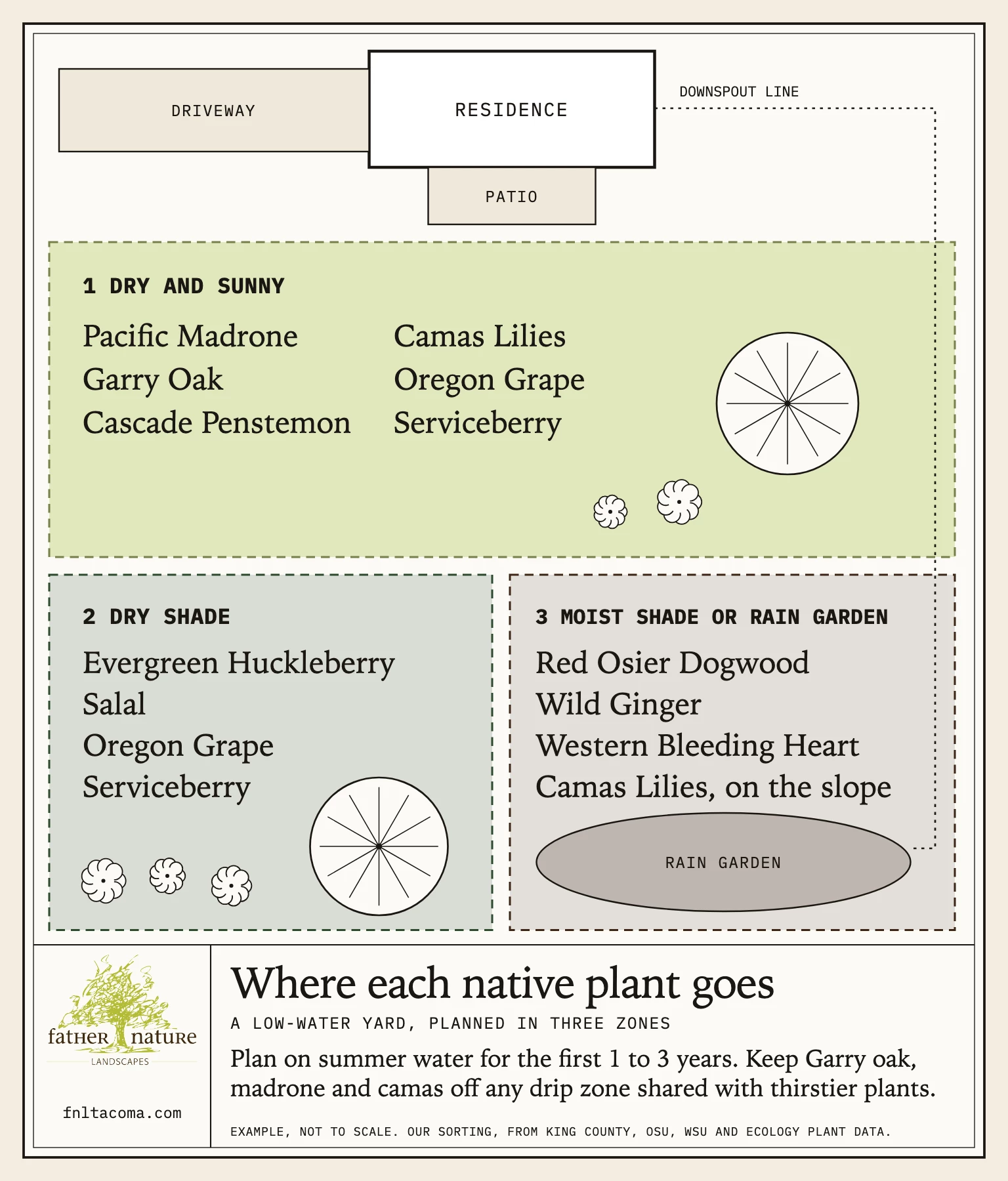
- A low-water yard is planned in three zones: dry and sunny, dry shade, and moist shade or the rain garden.
- Even the tough ones need summer water for their first one to three years, so the plan still includes irrigation.
- Garry oak, camas and madrone stay off the summer water once they’re established. For them, a sprinkler can do real harm.
- Red osier dogwood and wild ginger aren’t dry-yard plants. They belong in the wet part of the yard, such as the rain garden.
Water Savings with PNW Native Plants
A normal July in Tacoma brings 0.55 inches of rain, and a normal August brings 0.83. NOAA’s normals for the Tacoma #1 station put the full year at 40.81 inches, so those two months carry about 3.4 percent of it. November’s downpours don’t do much for a lawn in August.
Plants native to this side of the mountains are adapted to wet winters and dry summers. EPA’s WaterSense guidance says that once they’re established, native, regionally appropriate low-water plants “require little water beyond normal rainfall.” Normal August rainfall in Tacoma isn’t much, so each plant still has to fit its spot.
Dry years are real here too. The Department of Ecology’s statewide drought emergency took effect April 8, 2026 and runs through April 7, 2027 unless it’s ended sooner.
Perfect Native Plants for Your Plot
A plant is only drought tolerant in the right spot. Salal is an easy call in dry shade, and King County’s guide says it has a harder time in full sun.
So we sort the yard into what WSU Extension calls hydrozones, areas “where plants with similar water needs are grouped together.” For these eleven, that means three zones: dry and sunny, dry shade, and moist shade or the rain garden. Think of the bank along the south side of the driveway, the ground under the big trees at the back of the lot, and the low corner where the downspouts could go.
Here’s where each one lands. The sun, moisture and size come from the plant pages in King County’s Native Plant Guide, with water notes from OSU Extension’s guide to natives in water-wise landscapes and WSU’s dry shade list.
| Plant | Zone | Sun | Water once established | Size |
|---|---|---|---|---|
| Evergreen Huckleberry | Dry shade | Part shade to shade | Handles dry to moist ground | About 6 ft |
| Red Osier Dogwood | Rain garden or wet ground | Sun to shade | Wants moist to wet ground | 15 ft, forms thickets |
| Oregon Grape | Dry and sunny, or dry shade | Sun to shade | Handles dry or wet ground | 8 ft |
| Salal | Dry shade | Part shade to shade | Handles dry to moist ground in shade | 5 ft or more |
| Camas Lilies | Dry and sunny, or rain garden slope | Sun to part shade | Wet winter and spring, dry summer | 1 to 2 ft |
| Western Bleeding Heart | Moist shade, or rain garden slope | Part shade to shade | Likes damp, not soggy; dies back in summer | 1.5 ft |
| Penstemons (Cascade penstemon) | Dry and sunny | Sun to part shade | Handles dry to moist ground | 3 ft |
| Wild Ginger | Moist shade | Part shade to shade | Stays moist | 6 in |
| Pacific Madrone | Dry and sunny | Sun to part shade | Dry; keep it off regular summer water | Up to 90 ft |
| Garry Oak | Dry and sunny | Sun to part shade | Dry; irrigation risks root rot | 75 ft tall, up to 50 ft wide |
| Serviceberry | Dry and sunny, or dry shade | Sun to shade | Handles dry to moist ground | Up to 20 ft |
Native Shrubs for Dry Conditions
Three of these four stay green all year and give a yard its shape. The fourth is here for wet winter ground.
Evergreen Huckleberry
Evergreen huckleberry (Vaccinium ovatum) stays green all year, reaches about 6 feet and can be hedged, so it makes a screen under trees. King County rates this shrub for part shade to shade and dry to moist ground, and WSU lists it for dry shade around Puget Sound. The birds get the blue-black berries.
Huckleberry doesn’t transplant well, so we use smaller potted stock, and that means a little patience before you’ve got a real hedge. Keep this one off your sunny bank too.
Red Osier Dogwood
Here’s the first plant I’ll be straight with you about. Red osier dogwood (Cornus sericea) gives you red stems all winter, but this isn’t a dry-yard shrub. King County calls it “another plant for wetter areas, even right in shallow water,” and rates it for moist to wet ground. The Forest Service’s review says it’s “not particularly drought tolerant,” though that same page reports much tougher results in restoration studies.
At 15 feet, and forming thickets, this shrub needs room. I’ve kept it on this list because a rain garden needs a shrub too, and Ecology’s rain garden handbook lists red-twig cultivars for the basin, the slopes and the edge.
Oregon Grape
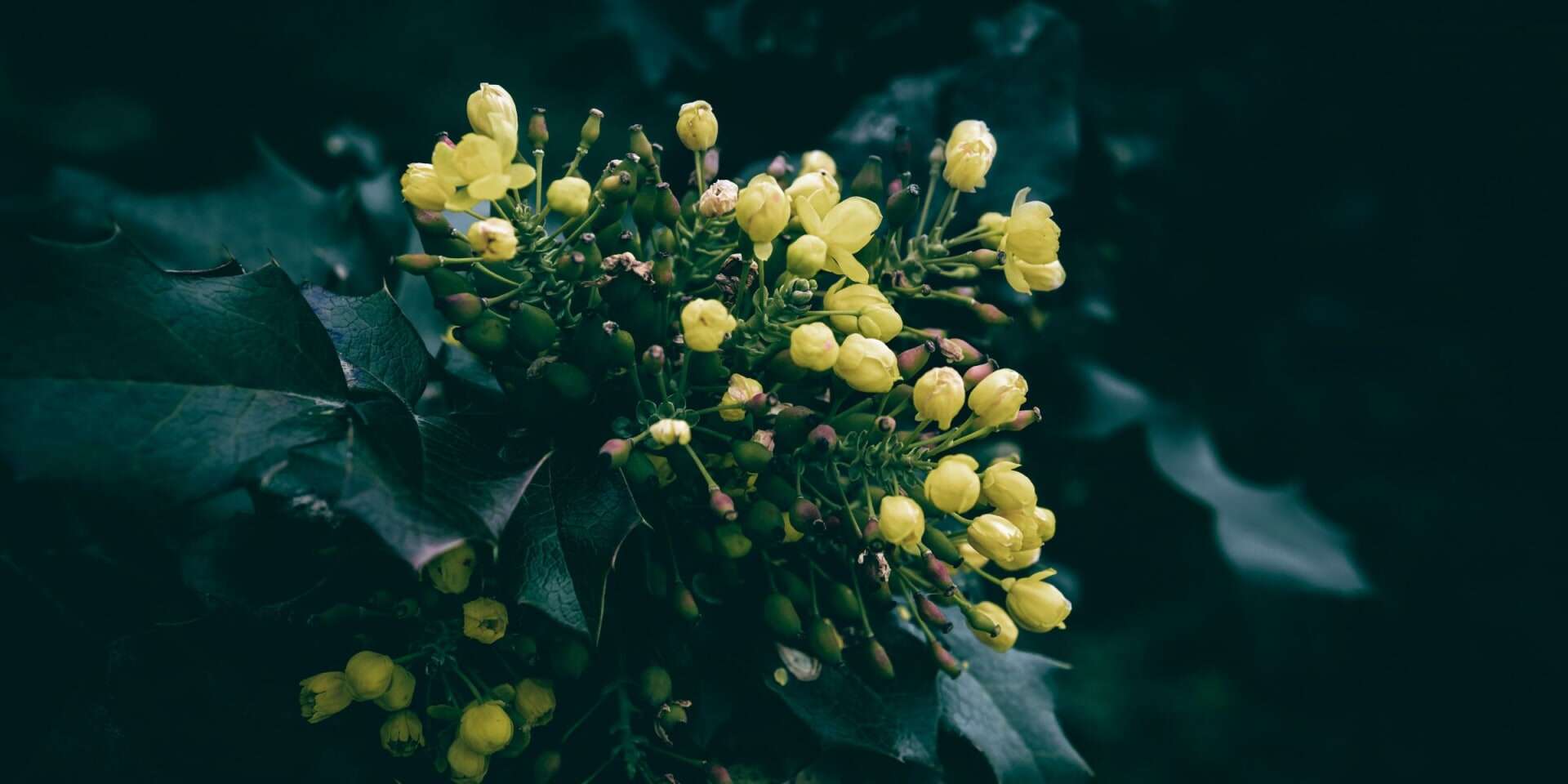
This is the most forgiving plant of the eleven. Tall Oregon grape (Mahonia aquifolium, and you may also see it listed as Berberis aquifolium) has holly-like evergreen leaves, bright yellow flowers and purple fruit, and that’s the plant at the top of this page. King County rates tall Oregon grape for sun to shade and dry to wet ground. At about 8 feet, with underground roots that spread, this shrub makes a barrier hedge along a property line. The spreading is also its limit, so we give it ground it can take over.
Salal
Salal (Gaultheria shallon) is the evergreen groundcover you see under trees across Western Washington. It gets to 5 feet or more, and it’s on WSU’s Puget Sound dry shade list. Plant it under trees, where a lawn gives up by July.
King County says salal “does have a harder time in full sun,” and there it needs to be well watered or near the coast. So keep it off the sunny bank, however good it looks at the nursery.
Native Perennials for Low-Water Landscapes
These four look different in August than they do in April, so we plan for that. Each one handles summer differently.
Camas Lilies
Camas sleeps through summer, and it needs to. OSU Extension calls it a seasonal wetland bulb that “requires summer dry periods to prevent rotting of the bulb.” So “drought tolerant” isn’t quite the right label. Camas wants a wet winter and spring, then a dry summer, so we keep it off the drip line. Common camas (Camassia quamash) takes dry to moist ground, and great camas (Camassia leichtlinii) wants it moist. Both take sun to part shade and send up spikes of bluish purple flowers. By August there’s nothing to see, so plant something beside it that fills the space.
Western Bleeding Heart
Western bleeding heart (Dicentra formosa) is a part-shade to shade plant that disappears on you. OSU says it dies back naturally in dry summer months, and King County describes it as “often melting away in the hot summer,” best in damper but not soppy-wet sites. That’s normal, and it isn’t dead, but it’ll look like a mistake if nobody planned for it. So it goes against something evergreen, like salal or huckleberry, so the spot isn’t bare in August. You get the heart-shaped, rose pink flowers in spring, then the salal or huckleberry beside it fills in.
Penstemons
Not every penstemon belongs in a Tacoma yard. Davidson’s penstemon, a species you’ll see on Northwest plant lists, is a rock garden plant, frequent on cliffs and talus slopes usually above 5,000 feet, and that isn’t what your yard looks like. For the lowlands, the better pick is Cascade penstemon (Penstemon serrulatus), which King County calls “one of the few penstemons found in the Puget Sound lowlands.” Give it sun to part shade and dry to moist ground. Plants reach 3 feet, and the purple trumpet flowers draw hummingbirds. Availability is low, so we’d order ahead rather than count on finding it the week of planting.
Wild Ginger
This is the least drought tolerant of the four. King County rates wild ginger (Asarum caudatum) for moist ground in part shade to shade, and it isn’t on WSU’s dry shade list or OSU’s water-wise list. It’s a low groundcover about 6 inches tall, with purplish flowers hidden under the leaves, the kind of detail you only find on your knees. It belongs under trees in moist shade or beside the rain garden, where an older edition of Ecology’s handbook listed it. Put it in a dry bed and you’ve signed up to water it.
Trees with Low Water Needs
On two of these three trees, the sprinkler can be the threat. Place them first in any plan, because trees are the plants you’ll live with longest.
Pacific Madrone
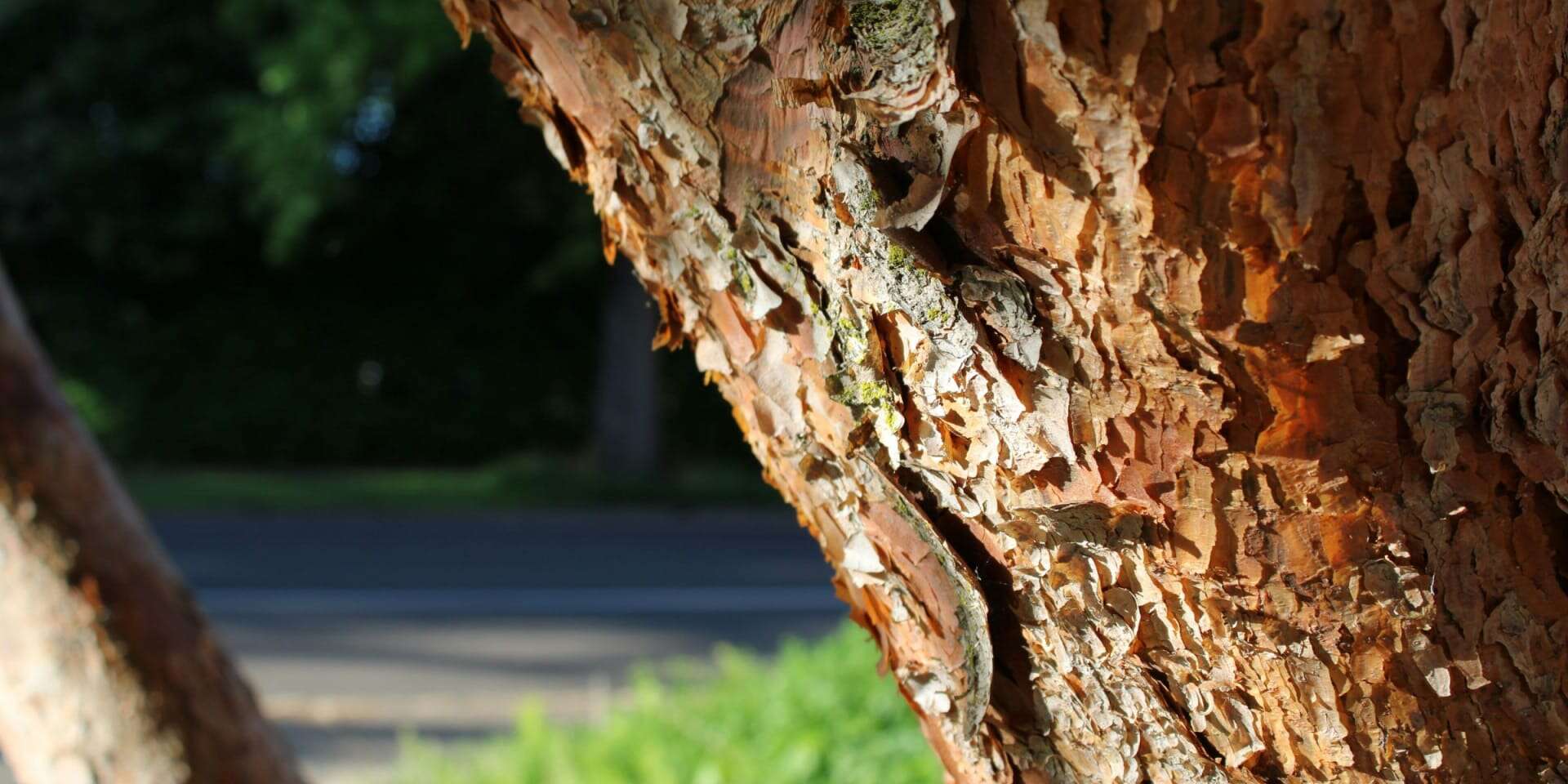
People want this tree for its bark, which peels back to show the wood underneath, and for the evergreen leaves. Madrone is also the riskiest plant on this page. King County’s data has Pacific madrone (Arbutus menziesii) reaching 90 feet in dry, coarse, well-drained rocky soil, and the same page says it’s “difficult to transplant, even as a sapling” and “doesn’t seem tolerant of the urban environment.” OSU Extension says to buy the smallest plants you can find and adds that madrones “don’t take well to tending by overly conscientious gardeners.” So I won’t promise you a madrone will make it.
If you want one anyway (and I understand why), plant it small, in the driest, best-drained ground you’ve got, nowhere near the lawn sprinklers.
Garry Oak
Garry oak (Quercus garryana), also called Oregon white oak, needs a big lot. King County lists it at 75 feet tall and up to 50 feet wide. Its toughness comes from below ground. On the gravelly soil at Fort Lewis, excavated trees had taproots of about 80 inches. And OSU says it’s “subject to root rot if irrigated,” so the lawn doesn’t go under it.
If you’ve already got one, we design around it. Pierce County code treats qualifying oaks as priority habitat subject to protection, including, within the urban growth area, a single oak 20 inches in diameter or larger. The City of Tacoma has its own code, so we check the rules for your address before anyone draws a patio under it.
Serviceberry
After those two, here’s the easy one. Serviceberry (Amelanchier alnifolia) grows up to 20 feet, takes sun to shade and dry to moist ground, and gives you something in three seasons: white flowers in spring, berries for the wildlife, and golden color in fall. As a large shrub or a small tree, serviceberry fits a lot that can’t take an oak.
Native Plant Watering
For the first one to three years, even these plants need water, which is why a low-water yard still gets an irrigation plan. Ecology’s handbook says summer irrigation will be necessary during the first 1 to 3 years after planting and may be necessary during droughts later on.
You’ll water at first. The goal is a yard that needs less each year, until you don’t have to water most of it in August. Here’s what we decide in the plan:
- Which beds get their own drip zone, and when that zone gets turned down.
- Which ground never gets a drip line. Camas, Garry oak and madrone stay off any zone shared with thirstier plants, and if a young one needs water in its first summers, that’s a separate call for that plant.
- Where the lines run, decided before the hardscape and the plants go in, so nobody cuts through a new patio to reach a bed.
EPA’s WaterSense guidance says turf areas and shrub areas should always be separated into different hydrozones, and its irrigation fact sheet says microirrigation delivers water directly to the root zone and uses 20 to 50 percent less water than conventional spray sprinklers.
Tie a Rain Garden Into the Drainage Plan
My co-owner, Cameron McGinnis, took on a Fircrest job like this. Here’s how he tells it:
“I was asked to look at a property in Fircrest where the lawn was constantly failing. Because the water table is so high in that part of town (it used to be a lake) a traditional lawn would never thrive. Instead we removed all of the lawn, and created a rain garden that captured the natural water and also the downspout lines from the roof. Instead of mushy wet lawn, they had a functioning infiltration system that used native plants that thrive in those conditions”
The rain you’ve been fighting in January can feed planting that won’t need the hose in summer, but those plants have to take both. Ecology’s 2024 rain garden handbook divides a garden into the basin, the side slopes and the edge, and says even the basin plants should tolerate our dry summers without extra water once they’re past establishment.
Several of the eleven are on its list. Red-twig dogwood cultivars go in all three areas. Camas, bleeding heart, salal, Oregon grape and serviceberry go on the slopes and the edge, and huckleberry goes at the edge. The handbook also says a rain garden shouldn’t sit within 10 feet of a foundation, near the edge of a steep slope, or where winter groundwater rises within a foot of its bottom. That rules out a lot of soggy corners, which is why we place it in the design and don’t dig it where the puddle is. Our posts on diagnosing backyard drainage problems and what each drainage fix does cover the rest of the water.
Where the Plants Fit in a Renovation
Plants go in last, after the grade, the drainage, the irrigation and the hardscape, so the excavator and the pallets of pavers don’t crush them. But they’re chosen at the same time as all that, because we decide these together in the plan for the whole yard:
- Which ground stays wet and which stays dry.
- Where the lawn shrinks to, and what takes its place.
- What you see from the kitchen window in January, and again in August.
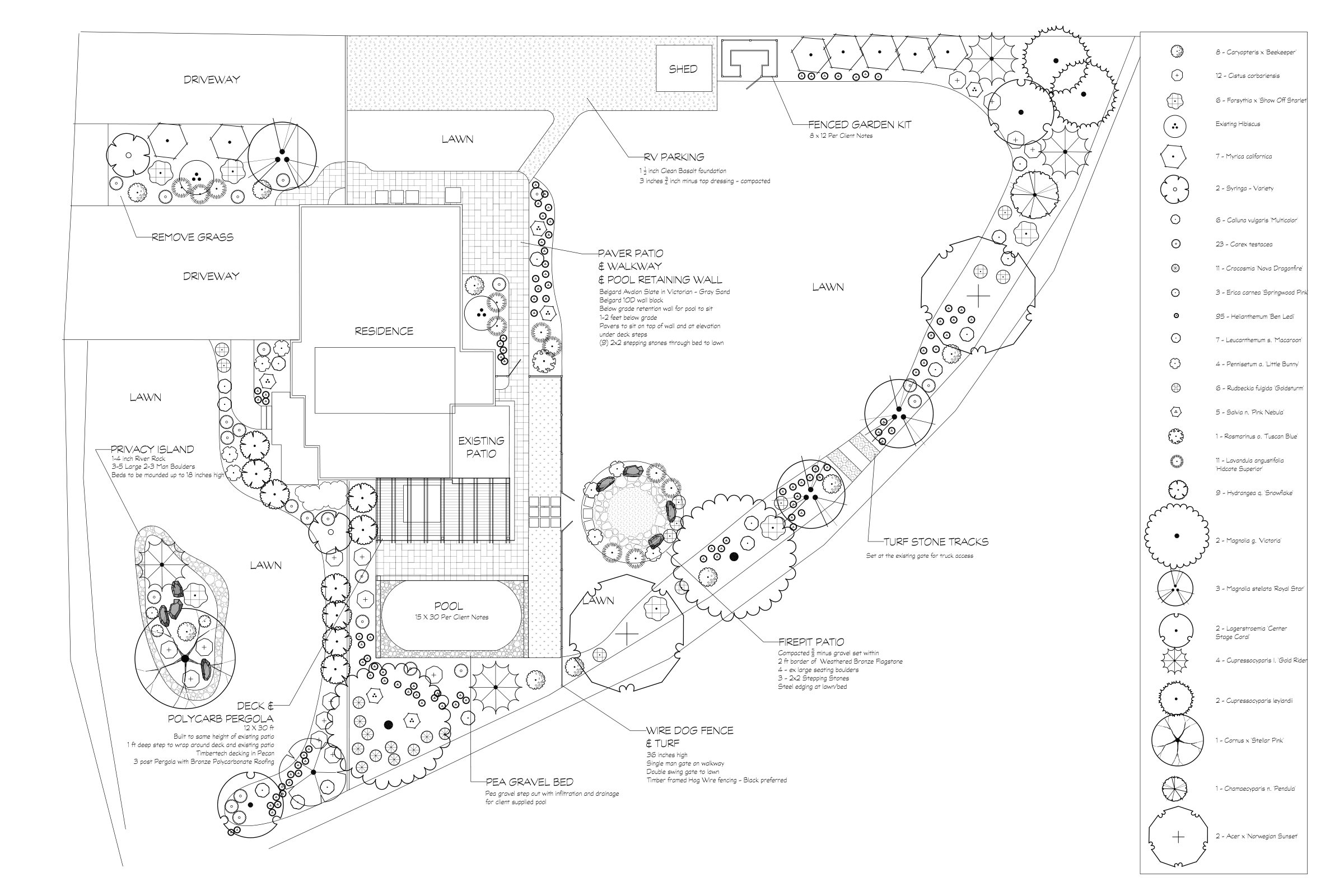
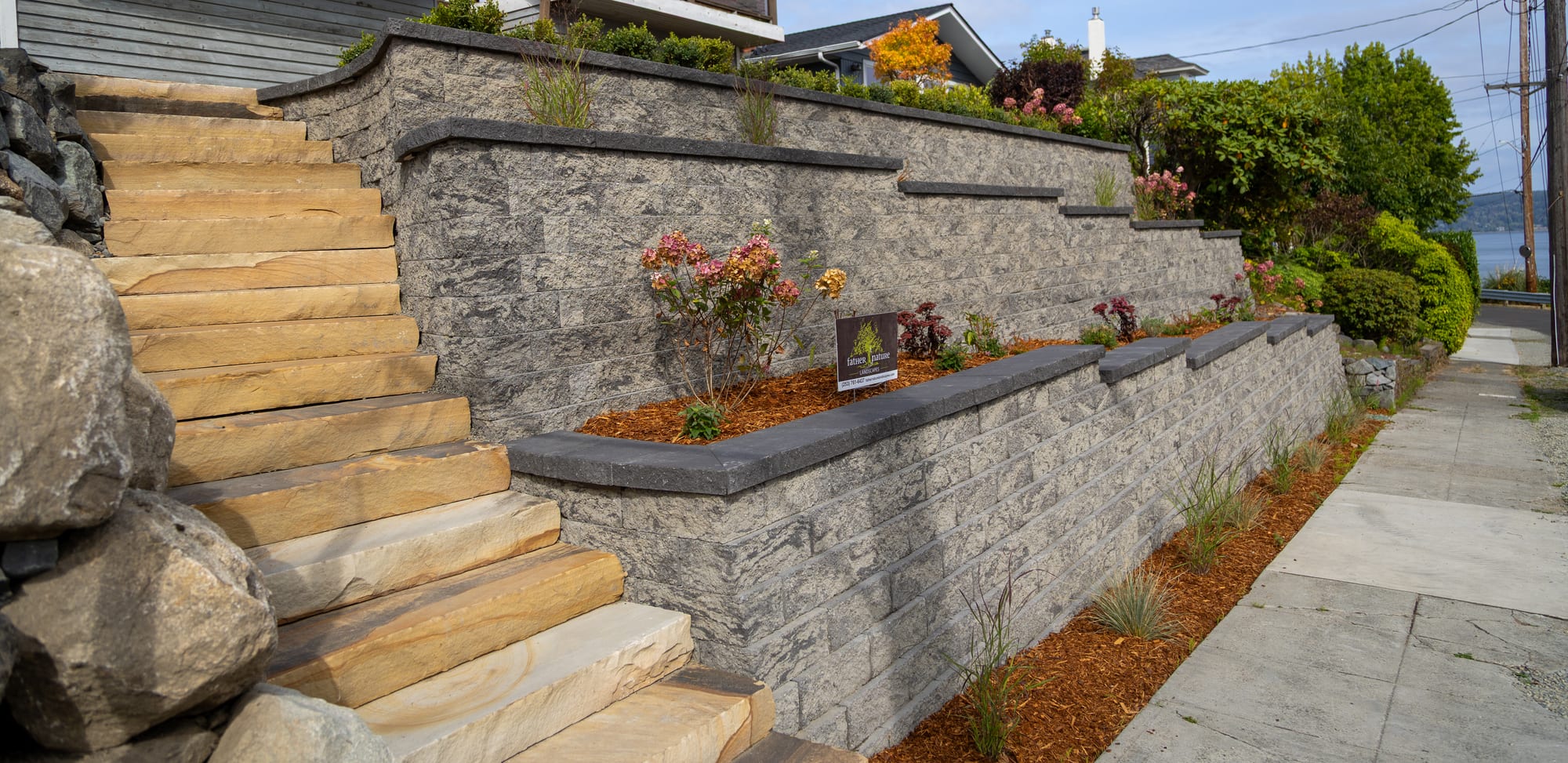
Glenn S. had English ivy that had gotten out of control over 41 years at the house, and wrote in a Google review, “The Father Nature crew yanked out truckloads of it and made a low-maintenance yard for me in the front yard and a new lawn in the backyard.” A low-water plan can keep some lawn. We decide where it goes and give it its own zone.
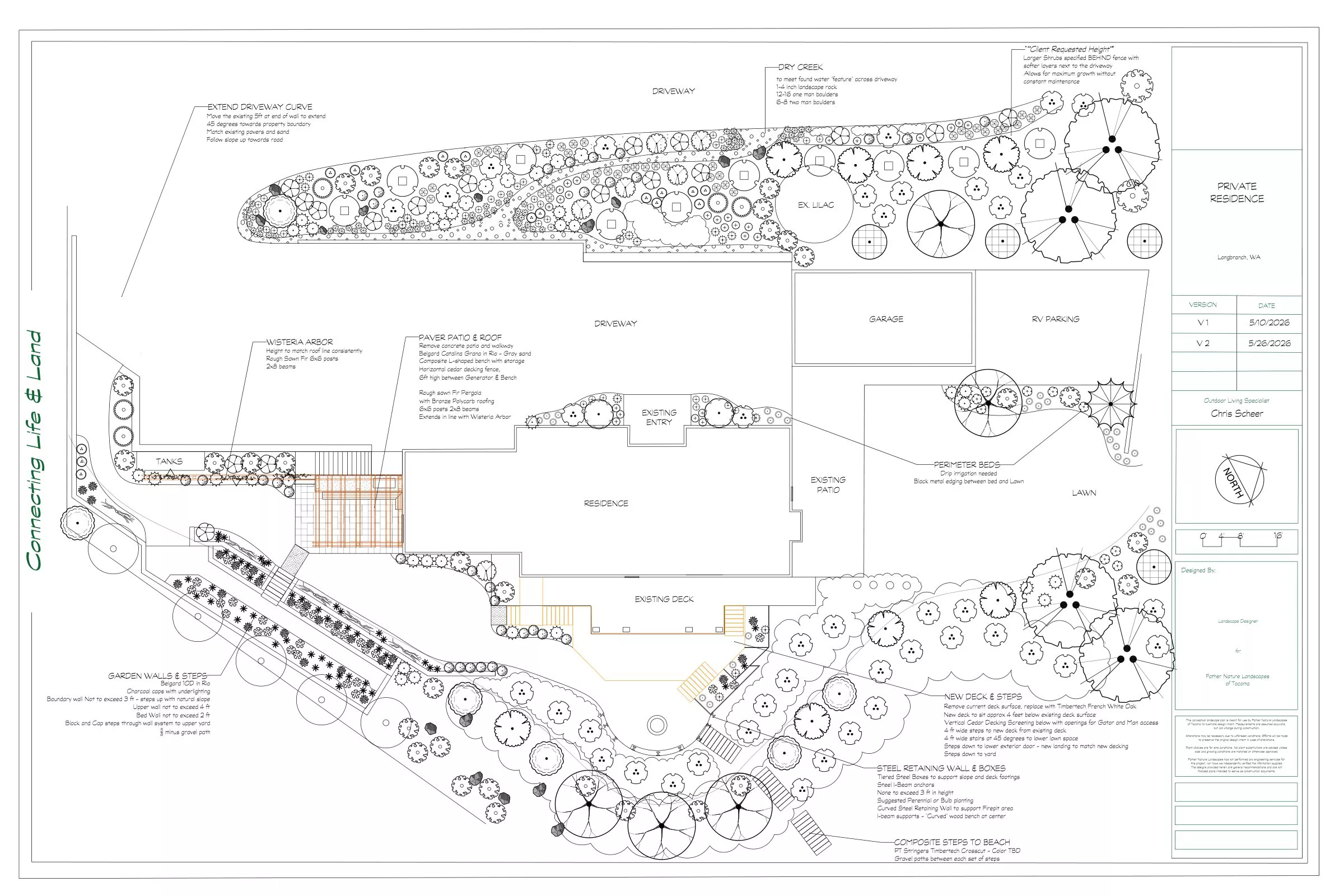
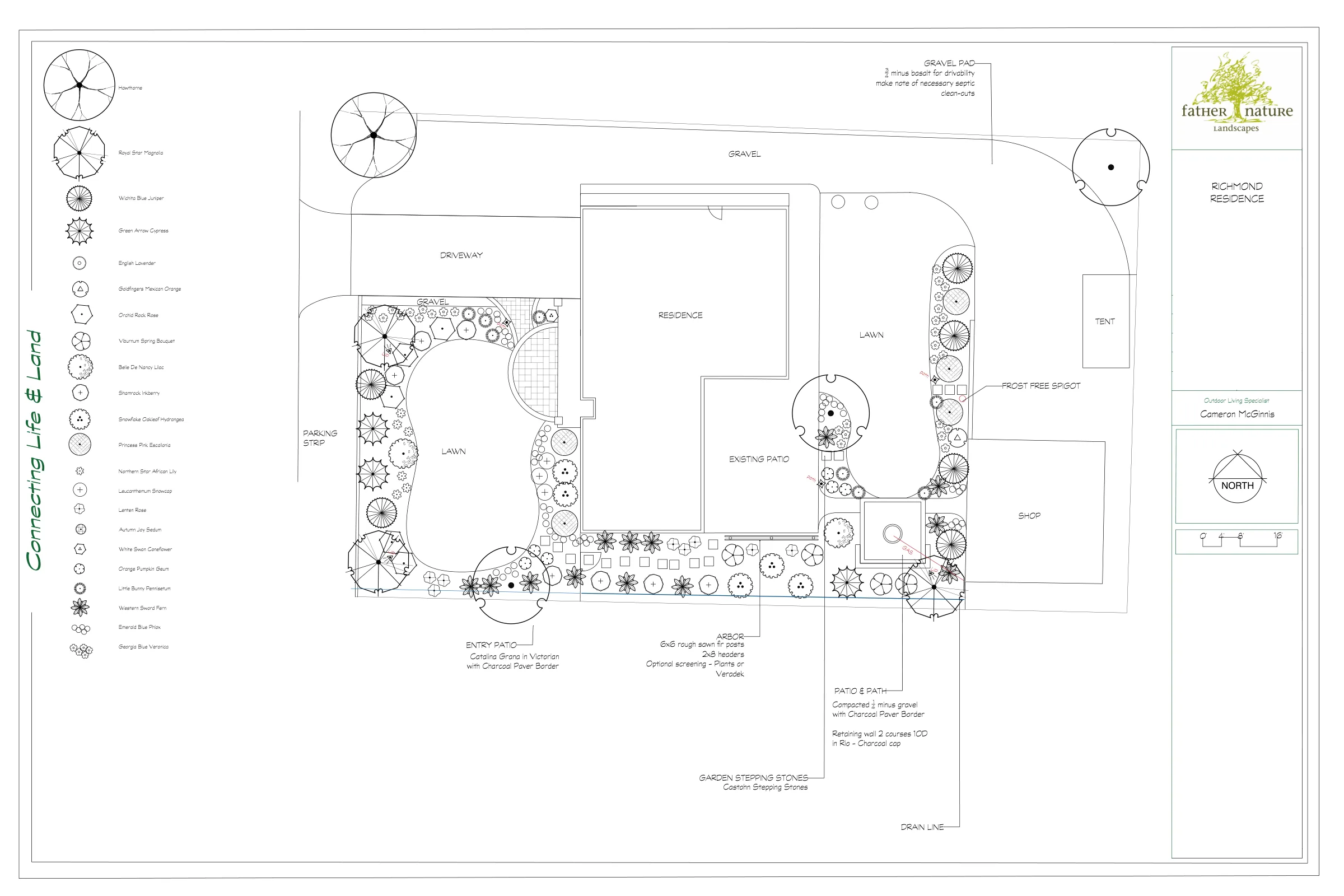
That’s the work of conceptual landscape design, a scaled plan of the whole property. Cameron or I lead it with you, and our design partner does the drawings. Our guide to backyard renovation in Tacoma walks through how the rest of a project comes together.
Frequently Asked Questions about Drought-Resistant Native Plants
What are the best drought tolerant evergreen shrubs for the Pacific Northwest?
Of these eleven, evergreen huckleberry, Oregon grape and salal. Huckleberry and salal want part shade to shade. Oregon grape takes anything from full sun to shade, so it’s the one for a sunny spot.
Do native plants need watering at all?
Yes, at first. Plan on one to three years of summer water for most of them, then little or none depending on the plant. A few, like Garry oak and camas, can be harmed by summer irrigation, so more isn’t safer.
Can I mix non-native plants with natives?
Yes, as long as they share a zone with plants that need the same water. A thirsty plant in a dry zone either dies or makes you water the whole zone more. If you’ve got favorites you want to keep, tell us and we’ll find them the right ground in the plan.
Sources
- NOAA NCEI, U.S. Climate Normals 1991-2020, Monthly, Tacoma #1
- King County, Native Plant Guide
- OSU Extension, Incorporating Pacific Northwest Native Plants Into Your Water-Wise Landscapes
- OSU Extension, Grow Oregon’s Iconic Madrone With Care and Patience
- WSU Extension, Planting in Dry Shade
- USDA Forest Service, Fire Effects Information System, Redosier Dogwood
- USDA Forest Service, Fire Effects Information System, Oregon White Oak
- University of Washington, Propagation Data Sheet, Penstemon davidsonii
- Washington Department of Ecology, Rain Garden Handbook for Western Washington, 2024
- Washington Department of Ecology, Rain Garden Handbook for Western Washington, 2013
- Washington Department of Ecology, 2026 Drought Order and Determination
- EPA WaterSense, Water-Smart Landscapes
- EPA WaterSense, Irrigation Products Fact Sheet
- Pierce County Code 18E.40.020