Tacoma summers fool a lot of homeowners. We get 40 inches of rain annually, so a dry garden feels like a personal failure. It isn’t. From mid-June through September, the Pacific Northwest shifts into a Mediterranean climate pattern, and less than one inch of rain falls per month. I’ve spent 20+ years designing landscapes across Tacoma, Gig Harbor, and Puyallup, and the single biggest upgrade I recommend is switching to drought-tolerant plants for Tacoma summers. Some good examples are Oregon grape, Pacific madrone, lavender, Russian sage, blanket flowers, and vine maple. Your yard stays vibrant, your water bill drops, and your weekends stay yours.
Chris’ Quick Takeaways
- Tacoma gets under one inch of rain per month from June through September. Plan your plant list around that reality, not the annual average.
- “Drought-tolerant” is not a pass to skip watering. New plants need consistent water for their first two full seasons.
- Native plants like Oregon grape, kinnikinnick, and vine maple evolved for our exact conditions.
- Match plants to your specific microclimate first. Sun exposure and slope orientation matter more than any plant list.
- Bark mulch at three to four inches deep is the single cheapest, highest-return investment in any drought-tolerant garden.
- Hydrozoning saves water and saves plants. Never mix high-water and low-water plants in the same bed.
- Tacoma’s summers are getting hotter and drier every decade. The time to rethink your landscape is before next August, not during it.
Tacoma Summers Are Drier Than Most People Expect
The Mediterranean Climate Pattern Behind Western Washington’s Dry Season
Most people associate the Pacific Northwest with rain. That reputation is earned, but only for half the year. Western Washington actually follows a Mediterranean climate pattern, with wet mild winters and genuinely dry summers. The Cascade Mountains block moist Pacific air differently as seasons shift, leaving Tacoma in a rain shadow from June onward. I’ve watched this pattern surprise homeowners every single year.
How Much Rain Tacoma Actually Gets From June Through September
The numbers tell a story most Tacoma homeowners haven’t read. According to WSU Extension’s Drought Tolerant Landscaping for Washington State, the Puget Sound area receives less than one inch of rain per month during summer, despite averaging 40 inches annually. That gap between perception and reality is exactly why I see so many water-thirsty landscapes struggling silently through July and August each year.
A couple in their late 40s from the North End of Tacoma came to us in 2019 puzzled by their browning garden beds. They had assumed Tacoma’s reputation for rain meant their plants were fine without supplemental watering. It turned out their entire planting scheme was built for year-round moisture. Summer dry periods had quietly stressed every plant in their yard.
What Increasing Heat Domes Mean for Your Existing Plantings
This is where things get serious for your yard. Washington has already warmed nearly 2°F since 1900, and the Washington State Department of Ecology projects extreme heat days to increase 6 to 9 times by the 2050s. Heat domes trap hot air over our region for days, accelerating moisture loss from both soil and leaves. Plants that managed fine a decade ago are now showing water stress they simply cannot handle without intervention.
What “Drought-Tolerant” Really Means for Tacoma Gardeners
Difference Between Drought-Tolerant, Low-Water, and Drought-Resistant
These three terms get used interchangeably, but they mean different things. Drought-tolerant plants survive extended dry periods once established. Low-water plants need occasional summer irrigation even after establishment. Drought-resistant plants are the toughest category, pushing through water stress with minimal visible decline. Knowing which label applies to your plant list saves you from unpleasant surprises in August.
Why Even Tough Plants Need Help in Their First Two Seasons
A retired engineer in his early 60s from Gig Harbor planted a full drought-tolerant garden in spring 2021 and watered nothing after week two. By August, half his plants were dead. The issue wasn’t his plant selection. It was timing. Even the toughest NW natives need consistent watering through their first one to two full growing seasons before their root systems can sustain themselves independently.
WSU Extension confirms that landscape plants commonly take one to two years to fully establish. Until root systems reach deep, stable soil moisture, supplemental watering is non-negotiable, regardless of how drought-tolerant the plant label reads.
How Plant Anatomy Determines Water Survival
Drought tolerance is built into a plant’s physical structure. Here is what to look for when choosing landscaping plants for Tacoma’s dry summers:
- Waxy or hairy leaves reduce moisture loss through transpiration
- Deep root systems access water far below the dry surface layer
- Small or finely divided foliage limits total surface area exposed to heat
- Succulent leaves store water internally as a built-in reserve
- Silvery or gray foliage reflects sunlight, reducing heat absorption
Conifers are a good example, combining small needles with waxy cuticles to minimize water loss naturally.
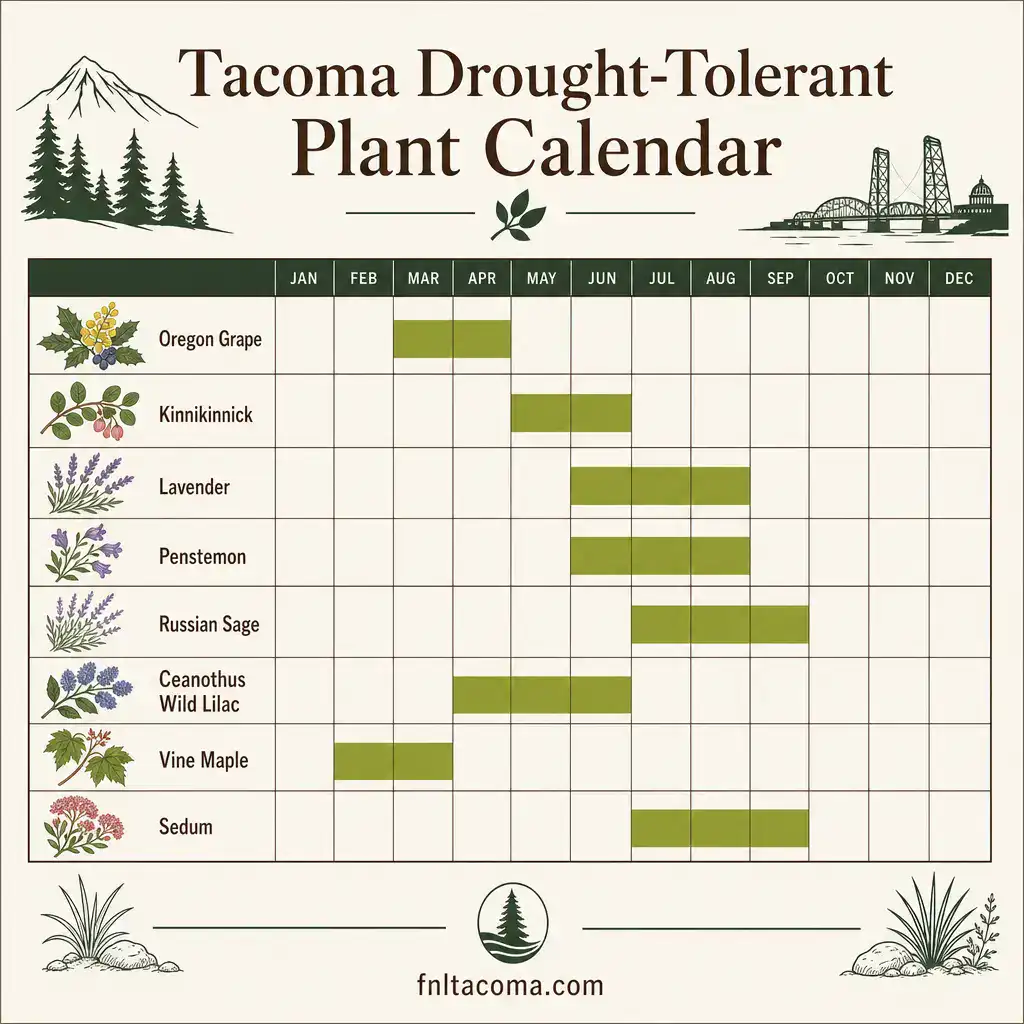
Best Native Drought-Tolerant Plants for Tacoma Summers
1. Oregon Grape (Mahonia aquifolium)
Oregon grape is one of the most reliable native plants I recommend for Tacoma properties. Its holly-like leaves stay evergreen through summer dry periods without any supplemental irrigation once established. It handles full sun to partial shade, produces fragrant yellow flowers in late winter, and feeds pollinators before most other plants even wake up. Mature plants reach four to six feet tall and work beautifully as a structured hedge.
2. Red Flowering Currant (Ribes sanguineum)
Few native shrubs deliver as much early-season color as red flowering currant. Deep pink flower clusters appear in March, attracting hummingbirds before summer dry periods even begin. After establishment, this shrub asks for almost nothing through Tacoma’s dry months. It works well in rain gardens, along slopes for erosion control, and as an informal hedge. OSU Extension research confirms it is one of the most reliable NW natives for waterwise gardening.
3. Pacific Madrone (Arbutus menziesii)
Pacific madrone is arguably the most visually striking native tree in the Pacific Northwest. Its peeling, rust-colored bark and glossy evergreen leaves create year-round interest that no imported ornamental can replicate. Deep root systems allow it to access moisture well below the dry summer surface, making it exceptionally resistant to water stress. I’ve placed it on south-facing slopes across Tacoma where almost nothing else survives August without irrigation.
A family in University Place with a steep, sun-baked south-facing slope spent three summers watching imported plants fail one after another. In 2022, we replanted the entire bank with Pacific madrone, kinnikinnick, and Oregon grape. Two summers later, the slope needed zero supplemental irrigation and the erosion that had troubled them for years had completely stopped.
4. Vine Maple (Acer circinatum)
Vine maple is the understory workhorse of PNW native selections. Unlike its thirstier maple relatives, vine maple handles summer dry periods gracefully once its root systems are established. It grows as a multi-stemmed large shrub or small tree, offering brilliant red and orange fall color that rivals anything in a nursery catalog. I regularly use it along woodland edges and shaded slopes across Tacoma and Gig Harbor properties.
5. Kinnikinnick (Arctostaphylos uva-ursi)
Kinnikinnick is one of the few truly excellent native ground covers for full sun and dry conditions. Its trailing evergreen stems form a dense, low mat that smothers weeds and controls erosion on slopes without any summer watering once established. Small pink flowers in spring give way to bright red berries that wildlife love through fall and winter. For hot, dry parking strips or rocky banks, this plant is genuinely hard to beat.
6. Penstemon (Penstemon davidsonii)
Penstemon brings color and life to a drought-tolerant garden when many other plants look tired. Tubular blooms in shades of purple, pink, and red appear through summer, attracting hummingbirds and supporting monarch butterfly populations and other pollinators during the driest months. Most penstemon species thrive in full sun with excellent soil drainage and zero summer irrigation after their first season. I use them as a mid-border accent alongside Oregon grape and kinnikinnick for contrast and bloom time variety.
Table: Native Drought-Tolerant Plants for Tacoma
| Plant | Type | Sun Needs | Water Once Established | Height | Best Use |
| Oregon Grape (Mahonia aquifolium) | Evergreen shrub | Full sun to full shade | Zero supplemental | 4–6 ft | Hedges, borders, woodland edges |
| Red Flowering Currant (Ribes sanguineum) | Deciduous shrub | Full sun to partial shade | Zero supplemental | 6–10 ft | Rain gardens, slopes, informal hedges |
| Pacific Madrone (Arbutus menziesii) | Evergreen tree | Full sun | Zero supplemental | 20–80 ft | Slopes, specimen tree, erosion control |
| Vine Maple (Acer circinatum) | Deciduous shrub/tree | Partial to full shade | Zero supplemental | 10–25 ft | Woodland edges, slopes, understory |
| Kinnikinnick (Arctostaphylos uva-ursi) | Evergreen ground cover | Full sun | Zero supplemental | 3–6 in | Slopes, parking strips, rock gardens |
| Penstemon (Penstemon davidsonii) | Perennial | Full sun | Zero supplemental | 6–12 in | Borders, rock gardens, pollinator beds |
| Oregon White Oak (Quercus garryana) | Deciduous tree | Full sun | Zero supplemental | 40–90 ft | Specimen tree, wildlife habitat |
| Evergreen Huckleberry (Vaccinium ovatum) | Evergreen shrub | Partial to full shade | Minimal | 2–8 ft | Dry shade, woodland gardens, hedges |
| Common Camas (Camassia species) | Bulb | Full sun to partial shade | Zero supplemental | 1–2 ft | Meadow plantings, pollinator gardens |
| Wild Ginger | Evergreen ground cover | Full to partial shade | Minimal | 6–8 in | Dry shade under trees, woodland floors |
Top Non-Native Drought-Tolerant Plants That Thrive in Tacoma’s Climate
1. Lavender (Lavandula spp.)
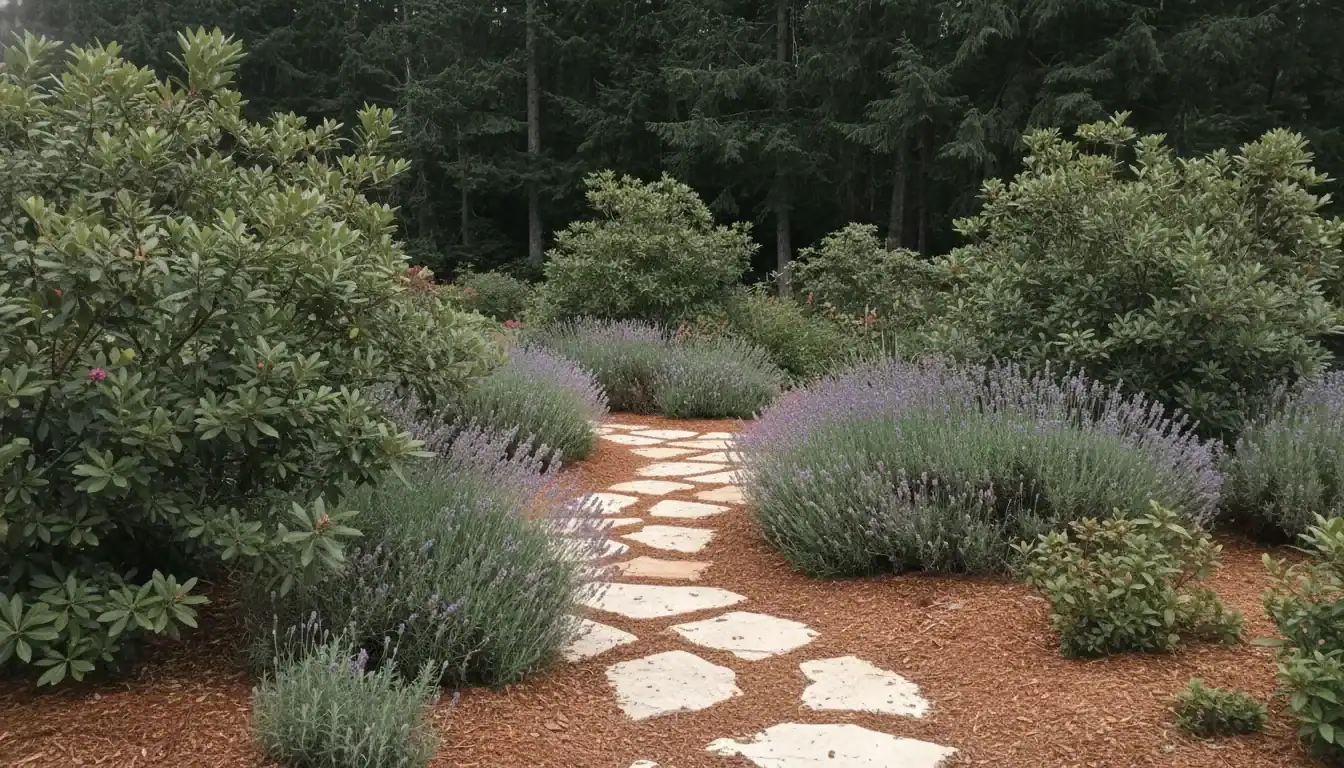
Lavender is one of those plants that performs almost embarrassingly well in Tacoma summers. It originates from the Mediterranean, which means our dry July and August conditions feel completely natural to it. Full sun, well-draining soil, and minimal summer water is genuinely all it needs once established. The aromatic silver foliage and purple flower spikes also make it one of the most sensory-rich choices in any drought-tolerant garden.
2. Russian Sage (Perovskia atriplicifolia)
Russian sage is a plant I reach for whenever a client wants late-summer color without late-summer watering. Its airy silver stems and violet-blue flower spikes bloom from July through September, exactly when most other plants are struggling through Tacoma’s dry season. It thrives in full sun and tolerates poor, rocky soil exceptionally well. Plant it behind lower ground covers like kinnikinnick or blue fescue for a layered, low-maintenance planting with real visual depth.
3. Sedum and Stonecrop Varieties
Sedums are built for drought in the most literal sense. Their succulent leaves store water internally, giving them a biological reserve that most plants simply do not have. Varieties like Autumn Joy produce dusty pink flower heads in late summer that transition to copper through fall, extending seasonal interest well past bloom time. I use sedum extensively in hot, dry situations along south-facing borders, rock gardens, and low-water container plantings across Tacoma properties.
A professional couple in their early 50s from Puyallup renovated their front yard in 2023 with a strict low-maintenance brief. Their south-facing slope received full sun all day and drained so fast that conventional plants wilted within weeks. We planted a combination of Russian sage, sedum, lavender, and rockrose across the entire bank. By the following August, the slope looked better than it ever had with zero supplemental irrigation.
4. Rockrose (Cistus spp.)
Rockrose is an underused gem in Tacoma’s waterwise gardening scene. This Mediterranean shrub produces papery, rose-like flowers in white, pink, and purple through early summer, with sticky, fragrant foliage that releases its scent in the heat. It thrives in poor, well-draining soil and actually performs better without rich amendments. Shorter varieties make excellent mounded ground covers for hot, dry parking strips, while taller selections work well as low-maintenance screening shrubs.
5. Blue Fescue (Festuca glauca)
Blue fescue earns its place in almost every drought-tolerant garden design I put together. Its fine, steel-blue foliage forms tight, architectural clumps that contrast beautifully against the silver tones of lavender and Russian sage. It handles full sun and dry soil without complaint once established, making it one of the most reliable low-water ground covers available for Tacoma’s USDA Zones 8b to 9a. Use it as edging, in mass plantings, or between stepping stones for a crisp, contemporary look.
Table: Non-Native Drought-Tolerant Plants That Perform in Tacoma’s Climate
| Plant | Origin | Sun Needs | Bloom Time | Height | Standout Feature |
| Lavender (Lavandula spp.) | Mediterranean | Full sun | June to August | 1–3 ft | Fragrant, pollinator magnet, deer resistant |
| Russian Sage (Perovskia atriplicifolia) | Central Asia | Full sun | July to September | 3–5 ft | Silver stems, late-season violet color |
| Sedum / Autumn Joy | Europe/Asia | Full sun | August to October | 1–2 ft | Succulent leaves, four-season interest |
| Rockrose (Cistus spp.) | Mediterranean | Full sun | May to June | 2–5 ft | Fragrant foliage, poor soil tolerant |
| Blue Fescue (Festuca glauca) | Europe | Full sun | Ornamental grass | 6–12 in | Steel-blue foliage, architectural texture |
| Lamb’s Ear | Turkey/Iran | Full sun | June to July | 12–18 in | Soft silver foliage, extreme heat tolerant |
| Black-eyed Susan | North America | Full sun | July to September | 2–3 ft | Long bloom time, monarch butterfly magnet |
| Blanket Flowers | North America | Full sun | June to October | 1–3 ft | Longest bloom time of any summer perennial |
| California Fuchsia | Western US | Full sun | August to October | 1–3 ft | Hummingbird magnet, thrives in hot dry spots |
| Fountain Grass | Africa/Asia | Full sun | August to October | 2–5 ft | Dramatic movement, tolerates poor dry soil |
| Smoke Bush | Central Asia | Full sun | Summer foliage | 10–15 ft | Smoky purple plumes, outstanding fall color |
| Daphne transatlantica | Mediterranean | Partial shade | April to October | 2–3 ft | Fragrant, extended bloom, low water needs |
How to Choose Drought-Tolerant Plants for Tacoma Summers Based on Your Yard
Matching Plants to Sun Exposure and Slope Orientation
Sun exposure is the single most important variable I assess before recommending any plant. A south-facing slope in full sun needs completely different adaptive plants than a north-facing bed that sees three hours of light daily. Use this as a quick guide:
- Full sun, south or west-facing: Lavender, Russian sage, rockrose, penstemon, blue fescue
- Partial shade, east-facing: Red flowering currant, vine maple, Oregon grape
- Full shade, north-facing: Wild ginger, Dicentra formosa, Athyrium filix-femina
Matching plant form to exposure from the start eliminates most of the failure I see in DIY drought-tolerant gardens.
What to Do With Dry Shade Areas Under Established Trees
Dry shade under a mature Douglas fir or Oregon white oak is one of the most frustrating microclimates in a Tacoma yard. The tree canopy blocks rain and the root systems compete aggressively for any soil moisture that does penetrate. Wild ginger, Dicentra formosa, and Athyrium filix-femina all handle this combination reliably. Evergreen huckleberry (Vaccinium ovatum) is another excellent native selection for dry shade that most homeowners overlook entirely.
Choosing the Right Plants for Slope and Erosion-Prone Spots
A homeowner in her late 30s near Point Defiance reached out in spring 2024 after losing most of her hillside plantings to winter erosion. Her steep slope faced southwest and baked through summer. We replanted with kinnikinnick, creeping Oregon grape, and rockrose. Root systems knitted the soil together within one season and the slope held cleanly through the following wet winter without losing a single plant.
Slopes need plants with spreading, fibrous root systems that bind soil and tolerate both seasonal saturation and summer drought. Kinnikinnick, creeping Oregon grape, and native bunch grasses all perform well in these hot and dry situations across the Tacoma region.
How to Prepare Your Soil Before Planting for Maximum Drought Survival
Tacoma’s Native Soils Are Actually Your Advantage
Most homeowners apologize for their soil. I tell them to stop. Tacoma’s native soils, including its glacially deposited loams and well-draining gravelly structures, are actually well-suited for drought-tolerant plantings. Many Mediterranean-climate plants and PNW natives evolved in lean, mineral-rich soils with good drainage. Planting them in heavily amended, moisture-retentive soil can cause more harm than planting them in the native ground as-is.
When to Add Organic Matter and When to Skip It
Twin brothers in their mid-40s renovating a Tacoma home in 2020 amended every bed heavily with rich compost before planting lavender, rockrose, and Oregon grape throughout. Within one season, the lavender had rotted at the crown and the rockrose showed classic root rot symptoms. Rich organic matter had retained too much moisture around roots that specifically need sharp soil drainage to thrive through summer.
Adding organic matter genuinely helps plants like vine maple and red flowering currant that prefer moderate moisture retention. Skip it entirely for Mediterranean plants and natives adapted to lean, well-draining conditions. Improving soil drainage rather than moisture retention is almost always the right move for a waterwise garden in Tacoma.
Mulching Strategies That Cut Summer Water Loss Significantly
Organic mulch is one of the highest-return investments in any drought-tolerant garden. A 2025 peer-reviewed study in Taylor & Francis Online found mulch reduces soil evaporation by 28 to 58.8% and increases soil moisture retention by up to 22%. I recommend applying bark mulch at three to four inches deep around all new plantings. Keep mulch pulled back slightly from plant crowns to protect soil microbes and prevent moisture buildup against stems.
Watering Newly Planted Drought-Tolerant Plants the Right Way
The Deep-and-Infrequent Watering Method Explained
Frequent shallow watering is one of the most common mistakes I see with newly planted drought-tolerant gardens. It trains roots to stay near the surface rather than driving downward toward stable soil moisture. Deep-and-infrequent watering means soaking the root zone thoroughly, then waiting until the top few inches are dry before watering again. This builds the deep root systems that allow plants to survive Tacoma’s summer dry periods independently.
A Simple Timeline for Weaning Plants Off Supplemental Water
Getting your watering schedule right from day one sets the entire trajectory of your drought-tolerant garden. I follow this general timeline with newly installed landscapes across Tacoma and Gig Harbor:
- Weeks 1 to 4: Water every two to three days, deeply
- Months 2 to 4: Reduce to once per week, deeply
- Months 5 to 12: Shift to every ten to fourteen days, monitoring for water stress
- Year 2 onward: Transition to rainfall only, with occasional deep supplemental watering during extreme heat
Washington has seen three consecutive drought emergencies from 2023 through 2025, according to the Washington State Department of Ecology. Building drought-independent root systems early protects your investment against an increasingly unreliable water supply.
Warning Signs That Your Established Plant Still Needs a Drink
A homeowner in her mid-50s from the Proctor District contacted us in summer 2023 convinced her two-year-old Oregon grape was dying. The leaves had gone dull and slightly cupped inward. It turned out that an unusually extended heat dome had pushed even her established plants past their threshold. One deep watering brought them back within days, with no lasting damage.
Even established drought-tolerant plants send clear signals when water stress crosses a tipping point. Watch for dull or matte leaf surfaces, inward leaf curling, and unusually early leaf drop as the clearest indicators that a deep drink is overdue.
How to Group and Design With Drought-Tolerant Plants for a Beautiful Tacoma Yard
Using Hydrozones to Group Plants by Water Need
Hydrozoning is the single most practical design principle I apply to every low-water landscape. A hydrozone is simply a planting area where every plant shares similar water needs, allowing one watering schedule and one drip irrigation zone to serve the entire group efficiently. WSU Extension’s drought landscaping guidance specifically recommends placing as many plants as possible into a low-water-use hydrozone. Mixing high-water and low-water plants in the same bed wastes water and quietly stresses the drought-tolerant ones.
Combining Textures, Bloom Times, and Heights for Year-Round Interest
A recently retired landscape enthusiast in his late 60s from Gig Harbor wanted a front yard that looked intentional year-round, not just in spring. In 2022 we layered Pacific madrone as the canopy, red flowering currant as mid-level structure, and kinnikinnick as ground cover. Penstemon and lavender filled the gaps for summer bloom time. The result was a four-season composition that required zero summer irrigation after its first year.
A well-designed drought-tolerant garden has something happening in every season. Layer tall structural plants like vine maple or Pacific madrone above mid-height shrubs, with low ground covers and blooming perennials filling the foreground for continuous color and texture across changing bloom times.
Hardscaping Features That Complement Low-Water Plantings
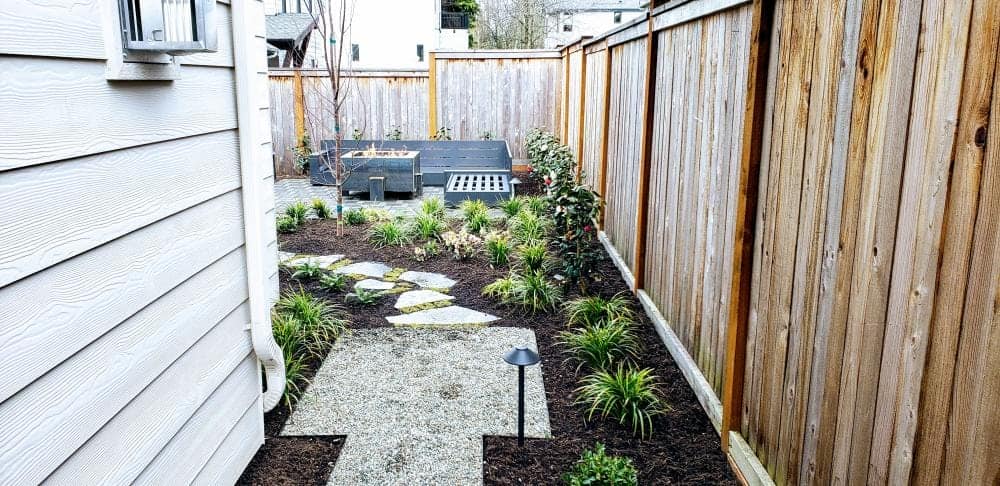
Hardscaping and drought-tolerant planting work better together than most homeowners expect. Permeable surfaces like decomposed granite, gravel paths, and flagstone allow rainfall to penetrate rather than run off, recharging soil moisture around plant root systems naturally. I regularly combine dry-stack rock walls with low-water plantings to create thermal mass that moderates soil temperature during heat events. These features reduce water stress on plants while adding structure and visual weight to the overall landscape design.
How Father Nature Landscapes Designs Water-Wise Outdoor Spaces in Tacoma
Our Approach to Selecting Drought-Tolerant Plants for Tacoma Summers
We never pull from a generic plant list. Every drought-tolerant garden we design starts with your specific yard conditions, sun exposure, soil drainage, and how you actually use your outdoor space. After500+ completed projects across Tacoma, Gig Harbor, and Puyallup, we know exactly which native plants and adaptive plants perform reliably through our summers.
What 20+ Years of Working With Tacoma’s Climate Has Taught Us
Tacoma’s climate punishes guesswork and rewards local knowledge. Since 2006, we have watched heat domes intensify, summer dry periods extend, and water restrictions tighten across Pierce County. That experience means we design for the climate we have now, not the one from a decade ago. Our plant selections, soil preparation, and watering schedules reflect real conditions on real Tacoma properties.
What a Water-Wise Landscape Design Consultation Looks Like With Our Team
It starts with a conversation, not a sales pitch. We assess your yard, discuss your goals, and recommend a drought-tolerant plant list tailored to your specific conditions. You get a professional conceptual landscape design, expert plant selection, and a clear plan before a single plant goes in the ground. schedule your free consultation bybooking online or call us at (253) 761-6437.
Frequently Asked Questions
1. Are blanket flowers and black-eyed susans good choices for Tacoma summers?
Both are excellent. Blanket flowers and black-eyed susans thrive in hot and dry situations, bloom for months, and require zero supplemental irrigation once established in well-draining Tacoma soil.
2. Does drought tolerance work in heavy clay soil?
Heavy clay complicates drainage, which most drought-tolerant plants need. Amend selectively or build raised planting areas to improve soil health before installing NW natives or Mediterranean species.
3. Can I attract monarch butterflies with a drought-tolerant garden?
Absolutely. Penstemon, California fuchsia, and lavender all support monarch butterfly populations and other pollinators through Tacoma’s dry summer months with minimal water use.
4. Where can I find drought-resistant native plants for my Tacoma yard?
I always recommend starting with native nurseries that specialize in PNW stock. The Washington Native Plant Society also maintains excellent regional plant lists organized by habitat and water need.
5. Do vine maples work near riparian areas or wet winter spots?
Vine maples are remarkably adaptable. They handle seasonal moisture in riparian areas during winter while tolerating summer dry periods better than most other native trees in our region.
6. Should I use drip irrigation for a low-maintenance drought-tolerant garden?
Drip irrigation is my preferred system for waterwise gardens. It delivers water directly to root zones, reduces moisture loss through evaporation, and supports smarter watering habits during Tacoma’s dry season.
7. What is the bloom timeline for a well-planned drought-tolerant Pacific Northwest garden?
A thoughtfully designed garden blooms from February through October. Red flowering currant and common camas open the season, penstemon and lavender carry summer, and smoke bush and sedum close fall beautifully.
8. Does bark mulch really make a difference for drought tolerance?
It makes a significant difference. Bark mulch reduces soil evaporation, regulates soil temperature, supports soil microbes, and cuts the supplemental watering your new plants need during their establishment period.
9. Are there drought-tolerant options like California poppies or wild lilacs for sunny Tacoma borders?
Both perform well in Tacoma’s climate. California poppies self-seed freely in full sun with zero irrigation, and wild lilacs like Ceanothus species handle hot and dry situations with impressive resilience.
10. Can permeable surfaces help my drought-tolerant garden perform better?
They genuinely can. Permeable surfaces allow rainwater to recharge soil moisture around plant root systems rather than running off, reducing water stress on your low-maintenance landscape during dry spells.
Conclusion
Tacoma summers are only getting drier, and the right plant choices make all the difference between a yard that thrives and one that quietly struggles every August. Since 2006, we have helped hundreds of Tacoma, Gig Harbor, and Puyallup homeowners build beautiful, water-wise landscapes that hold up through every dry season without consuming their weekends.
If you are ready to stop guessing and start growing,book your free consultation with our team today.